Most engineering teams building agent systems today spend exactly zero time thinking about the networking layer. They wire up MCP servers for tool access, bolt on an LLM gateway for rate limiting, and call it done — while every model call underneath still flows through the same inference infrastructure they set up for single-shot generations.
That worked in 2025. It will break in 2027.
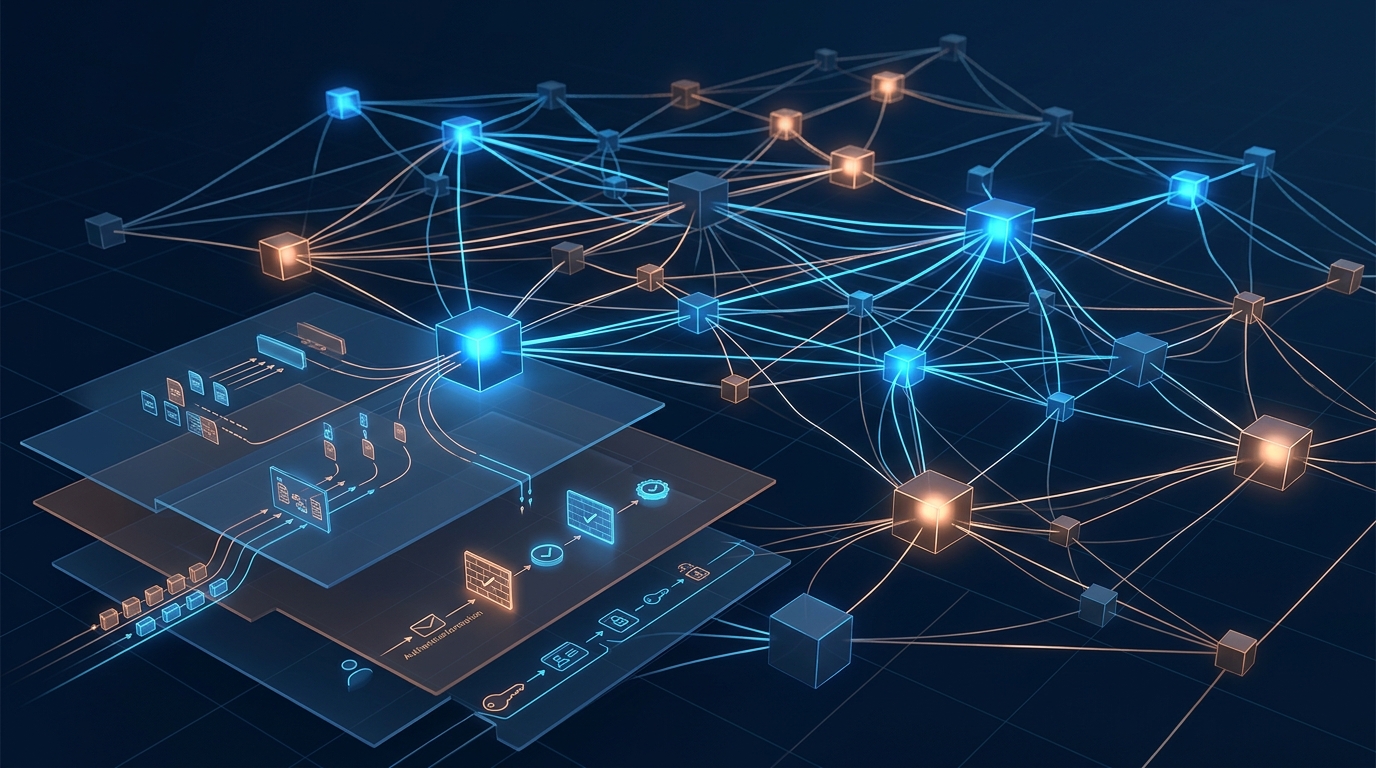
The agent mesh — the dedicated networking, identity, and policy layer that sits between agents — is consolidating faster than anyone predicted. April 2026 alone saw Cloudflare, Kong, and the broader A2A ecosystem ship production-grade agent networking products within the same week. This isn’t coincidence. It’s the infrastructure market recognizing that agent-to-agent communication is a first-class architectural problem, not a feature you bolt onto an API gateway.
We’ve spent the last 18 months running multi-agent systems across customer-facing RAG pipelines and internal workflow orchestrators. Here’s what we’ve learned: the N×N communication problem arrives sooner than you think, the identity model for agents is fundamentally different from service identity, and the vendors building the mesh layer are positioning for a market that most teams haven’t even realized exists yet.
What Is an Agent Mesh, Actually?
An agent mesh is the networking and policy fabric that enables autonomous agents to discover each other, communicate securely, negotiate tasks, and operate under shared governance — without requiring a centralized orchestrator to relay every message.
This is not a service mesh. A service mesh (Istio, Linkerd, Consul Connect) solves a different problem: routing HTTP/gRPC traffic between services that have known endpoints, static identities, and human-authored policies. An agent mesh has to handle:
- Dynamic discovery. Agents spin up and down based on task demand. An inventory agent might exist for 30 seconds to fulfill one stock-check request. The mesh can’t require pre-registration.
- Intent-based routing. Agents don’t call fixed endpoints. They declare capabilities (“I can check stock levels”) and the mesh routes requests based on what needs doing, not where something lives.
- Delegated authority chains. Agent A delegates to Agent B, which delegates to Agent C. Each hop narrows the permission scope. The mesh must enforce and audit this chain — it’s the security boundary.
- Protocol multiplicity. Production agent systems mix MCP (tool access), A2A (agent coordination), and proprietary framework protocols. The mesh can’t assume a single wire format.
As HatchWorks AI put it in their June 2026 reference architecture: the agent mesh is “the operating layer for agentic systems,” providing “discovery, connectivity, policy enforcement, and identity” across every agent regardless of framework, language, or cloud (HatchWorks, June 2026).
The Protocol Layer Set the Table
Before the mesh could exist, the industry needed a common language for agent communication. That language materialized faster than anyone expected.
MCP (Anthropic, November 2024) solved agent-to-tool communication. It hit 97 million downloads by early 2026 and is now the de facto standard for tool access across every major framework (Digital Applied, March 2026).
A2A (Google, April 2025) solved agent-to-agent coordination. The protocol defines an Agent Card — a JSON capability document — plus a task lifecycle, streaming support, and security schemes. By June 2026, A2A had 150+ supporting organizations and was deployed in production across Google Cloud, AWS, and Azure (Google Developers Blog, April 2025).
ARD (Agent Registry and Discovery, July 2026) closed the discovery gap. Published as an IETF draft, ARD uses .well-known/ai-catalog.json — essentially sitemap.xml for agents — to let agents find each other without hard-coded endpoints.
Together, these three protocols create the data plane: agents can discover each other (ARD), communicate intent (A2A), and access tools (MCP). What they don’t provide is the control plane — the networking, identity, and policy enforcement layer that makes all of this secure at scale.
That’s the mesh.
April 14, 2026: The Week the Mesh Layer Arrived
Two announcements on the same day crystallized the market.
Cloudflare Mesh: Private Networking for Agents
Cloudflare launched Mesh on April 14, 2026, describing it as “the first private networking solution of its scale built for the rise of AI agents” (Cloudflare Press Release, April 2026).
The product gives agents private, encrypted connectivity to internal infrastructure — staging databases, internal APIs, home lab servers — without exposing those services to the public internet. Think of it as the networking equivalent of what MCP did for tool access: a standardized, secure channel that replaces the bespoke VPNs, firewall rules, and SSH tunnels teams are cobbling together today.
The New Stack’s analysis nailed the framing: Cloudflare is betting that agents are “a new class of client” that needs networking infrastructure fundamentally different from what we built for browsers, mobile apps, and microservices (The New Stack, April 2026).
This matters because most teams don’t think about agent networking until their coding agent needs to reach a staging database, their procurement agent needs to talk to an internal ERP, and their customer-facing agent needs to query a vector store behind a corporate firewall — all simultaneously. Cloudflare Mesh makes this a product rather than a DIY project.
Kong Agent Gateway: A2A Traffic Governance
Kong shipped Agent Gateway within Kong AI Gateway 3.14 on the same day, becoming the first API gateway vendor to support “advanced LLM, MCP, and agent-to-agent (A2A) use cases” in a single unified control plane (Kong Blog, April 2026).
The architecture is instructive. Kong treats agent traffic as a distinct domain from API traffic, with its own governance primitives:
- Agent identity as a first-class concept. Every agent authenticates individually, not just the service it runs inside.
- In-transit prompt injection detection. Kong inspects A2A message payloads in real time and blocks malicious content — prompt injections, data exfiltration attempts, policy violations — between agents, not just at the model boundary.
- Per-agent cost allocation. Token consumption tracked and billed per agent identity, not per API key. If your research agent burns $12 in tokens and your summarization agent burns $3, you know it.
Gartner flagged this exact pattern in their 2026 Emerging Tech Adoption Radar: “Discoverability, negotiation and transaction between agent-to-agent (A2A) counterparts represent the next horizon — an emerging class of differentiated features for AI gateways” (quoted in Kong Blog, April 2026).
When Gartner calls a feature class “the next horizon,” the infrastructure vendors have already placed their bets. Kong and Cloudflare just happened to place theirs on the same day.
Kagent: Open-Source Agent Mesh on Istio
On the open-source side, Kagent is building an agent mesh on top of Istio Ambient Mesh — essentially extending Kubernetes’ service mesh primitives to handle agent-specific workloads. It supports CrewAI, Google ADK, and MCP tool servers natively, with agentgateway providing the bridge between agent protocols and mesh-level policy enforcement (Kagent, 2026).
The Kagent thesis: agent frameworks are not the problem. The problem is that every team using those frameworks ends up building their own observability, security, and connectivity layer. Kagent provides that layer as infrastructure, not application code.
The Event Mesh Argument
Not everyone agrees that the networking layer should be built on top of API gateway patterns. Solace, the event mesh vendor, has made a persuasive counter-argument: A2A without an event mesh underneath produces a polling-based architecture that doesn’t scale.
Their engineering team made the case that A2A’s default interaction model — send a task, poll for completion — creates latency and resource waste at scale. An event mesh inverts this: agents subscribe to capability-based topics, and results are pushed rather than polled. This matches the pub/sub pattern we explored in our event-driven agent architecture analysis: the threshold for needing an event backbone is surprisingly low — roughly three agents that need to coordinate.
We think both patterns will coexist. Kong and Cloudflare Mesh handle the north-south traffic (agents reaching external services and crossing organizational boundaries). Event meshes handle east-west traffic (agents within the same system coordinating in real time). A2A provides the common language across both.
The Hard Problem Nobody’s Solved: Agent Identity
Here’s where the mesh layer gets genuinely difficult: what’s the identity model for an agent?
A microservice has a stable identity — a Kubernetes service account, an SPIFFE ID, an OAuth2 client. It lives for weeks or months. Its permissions change on a human timescale.
An agent has none of these properties:
- Ephemeral. An agent might exist for 30 seconds to fulfill one request. Issuing and rotating certificates at that timescale breaks conventional PKI.
- Delegated. Agent A creates Agent B to handle a subtask. Agent B inherits a subset of Agent A’s permissions. The delegation chain can be three, four, five hops deep.
- Cross-organizational. Your procurement agent talks to a supplier’s fulfillment agent. They don’t share an identity provider. They don’t share a PKI. They probably run on different clouds.
LoginRadius published a thorough analysis of this problem in February 2026, arguing that agent identity requires “identity-bound protocols” where every message carries an unforgeable proof of delegation — a cryptographic chain tracing authority back to a human principal (LoginRadius, February 2026).
Kong’s approach is pragmatic: bind every agent to an OAuth2 client, enforce policy at the gateway, and log the delegation chain at each hop. It works today but doesn’t solve the cross-organizational case. ANP (Agent Network Protocol), the community-driven decentralized protocol, tackles this with DIDs and verifiable credentials — more ambitious, less production-ready.
Our bet: the identity problem will drive the next wave of agent mesh consolidation. Whoever ships a workable cross-organizational agent identity model — with delegation chaining, scope narrowing, and audit — wins the enterprise.
Where to Invest Now
If you’re building multi-agent systems today, here’s what the mesh layer means for your architecture, ordered by urgency:
1. Pick A2A as your inter-agent protocol. It’s the only protocol with multi-vendor production adoption, Linux Foundation governance, and native SDK support across Google ADK, Microsoft Agent Framework, and (via adapters) LangGraph and CrewAI. As we wrote in our Google ADK comparison, A2A is the protocol that determines which frameworks survive in the enterprise.
2. Add an event backbone when you hit three agents. Don’t wait for the N×N problem to manifest. NATS, Solace, or even Redis Streams will save you from a polling-based coordination architecture that collapses under load. We covered the threshold and patterns in event-driven agent architecture.
3. Treat agent identity as a distinct domain from service identity. Your Kubernetes service mesh does not solve this. Start thinking about per-agent OAuth2 clients, delegation chaining, and scope narrowing now — the tooling will catch up within 12 months.
4. Watch Cloudflare Mesh and Kong Agent Gateway. If your agents need to reach internal infrastructure, Cloudflare Mesh is the most mature product in the category. If you need A2A traffic governance with cost allocation and prompt injection detection, Kong’s Agent Gateway is the only game in town. Both are GA and shipping.
5. Budget for the mesh. Most teams haven’t allocated infrastructure spend for agent networking because the category didn’t exist 6 months ago. It exists now. The pattern from the API gateway market suggests early adopters get better pricing and deeper integration — don’t wait until it’s a line item in every competitor’s infrastructure budget.
What the Next 12 Months Look Like
The agent mesh layer is following the API gateway playbook at roughly 3× speed. In 2015, API gateways were a niche. By 2018, they were infrastructure table stakes. In 2026, agent meshes are a niche. By mid-2027, they’ll be infrastructure table stakes — and the vendors are moving accordingly.
Here’s what we expect:
-
Kong, Cloudflare, and the hyperscalers converge on A2A-native mesh products. Google Cloud’s Apigee already bridges APIs to A2A agents. AWS and Azure will follow within 2 quarters. The independent vendors (Kong, Cloudflare) will compete on multi-cloud and zero-trust.
-
The identity problem gets solved at the protocol layer. Expect a joint announcement from the Linux Foundation (which now governs MCP, A2A, and ACP) around agent identity standards by Q1 2027. ANP’s DID-based approach will influence the design, but the enterprise-grade solution will come from the A2A ecosystem.
-
The EU AI Act enforcement (August 2026) accelerates mesh adoption. Multi-agent systems in high-impact sectors are classified as “high-risk,” triggering mandatory human-in-the-loop oversight, immutable audit trails, and scenario-based testing. An agent mesh that provides unified observability and governance across all agent communication is the cheapest path to compliance.
-
Mesh-native agent frameworks emerge. Today’s frameworks treat networking as an implementation detail. The next generation — and we’re already seeing this in Microsoft Agent Framework 1.0’s native A2A support — will treat the mesh as a first-class architectural primitive.
The pattern is clear: every major shift in distributed computing produces a networking layer. Microservices produced service meshes. APIs produced API gateways. Agents are producing the agent mesh. The vendors who recognized this in April 2026 are placing a bet that most teams won’t understand until their agent sprawl forces them to.
By then, the mesh won’t be optional. It’ll be infrastructure.
Further reading:
- The AI Agent Protocol Stack: MCP, A2A & What Comes Next
- Event-Driven AI Agents Are Replacing the Request-Response Loop
- Google ADK vs OpenAI vs Claude Agent SDK: The 2026 Comparison
- Agent Architecture Is Converging — and That Changes How You Build
- Cloudflare Mesh: Private networking for the age of AI agents (The New Stack, April 2026)
- Kong Agent Gateway: The complete AI gateway for agent-to-agent communication (Kong Blog, April 2026)
- Agent Mesh Architecture: Stop Sprawl Before It Stops You (HatchWorks AI, June 2026)