Enterprise Agent Platforms: Salesforce vs ServiceNow vs Microsoft — June 2026

Salesforce Agentforce at $2/conversation. ServiceNow AI Agents bundled into ITSM tiers at $100–150/user/mo. Microsoft Copilot Studio at $200/tenant/mo for 25K credits. Which enterprise platform actually ships?
Your CIO approved the agent budget in Q1. It’s June and nothing’s in production yet. The board keeps asking about the “AI transformation” line item, and you’re still trying to figure out whether to bolt agents onto the CRM, wire them into your ITSM, or spin something up inside the Microsoft tenant you already pay for.
The enterprise agent platform market has consolidated around three incumbents: Salesforce Agentforce, ServiceNow AI Agents, and Microsoft Copilot Studio. Each promises to put AI agents inside the systems your teams already use. Each charges differently — very differently. And each has a fundamentally different opinion about what an “enterprise agent” actually is.
We spent two weeks comparing pricing, platform architecture, the developer experience, and the production track record. Here’s our honest take.
TL;DR: The 15-Second Verdict
| Criterion | Salesforce Agentforce | ServiceNow AI Agents | Microsoft Copilot Studio |
|---|---|---|---|
| Best for | CRM-embedded sales/service agents | IT and HR workflow automation | Internal knowledge agents in M365 shops |
| Core identity | Conversational AI inside Salesforce | AI-driven process automation | Low-code agent builder inside Power Platform |
| Pricing model | Flex Credits + per-conversation ($2) | Bundled in ITSM tiers; 20–40% uplift at renewal | $200/mo for 25K credits ($0.008/credit) or $0.01/credit PAYG |
| Agent scope | Customer-facing (service, sales, marketing) | Employee-facing (IT, HR, CSM) | Internal employee-facing; external available with standalone licensing |
| LLM flexibility | Salesforce-tuned models; BYO-LLM via Einstein | ServiceNow-tuned; limited external model support | Azure OpenAI models; bring your own via Azure |
| Self-hosted | No (SaaS only) | No (SaaS only) | No (SaaS only) |
| Vendor lock-in | High — CRM data model is the foundation | High — Now Platform workflows are the foundation | Medium-high — M365 tenant, Azure, Power Platform |
| Production evidence | Mixed — pricing whiplash signals adoption friction | Strong in ITSM; unproven outside IT/HR | Growing — credit-based model makes experimentation cheap |
If your agents need to work inside a CRM: Salesforce Agentforce. If you’re automating IT/HR workflows: ServiceNow AI Agents. If you’re already an M365 shop and want internal agents fast: Microsoft Copilot Studio.
The Pricing Story: Why It’s the First Question You Should Ask
Enterprise agent pricing in 2026 is a mess — and that’s being generous. Each vendor has built a pricing model around their platform’s existing monetization strategy, not around what makes sense for agent workloads.
Salesforce Agentforce: The $2 Conversation That Wasn’t
Salesforce launched Agentforce in late 2024 with a deceptively simple pitch: $2 per conversation. Customers immediately balked. What’s a “conversation”? Is a five-turn dialogue one conversation or five? What about agent-to-agent handoffs?
By May 2025, Salesforce introduced Flex Credits — a consumption-based system where businesses pay per action, not per conversation Source: MagicFuse. Then came per-user licensing. Then came volume discounts layered on top of Flex Credits. By early 2026, Salesforce had three overlapping pricing models running simultaneously — a situation SaaS pricing expert Jason Lemkin called “maybe right now, that’s the way to do it,” with the implication that it wouldn’t stay that way Source: SaaStr.
Our take: The pricing churn is a red flag. It signals that Salesforce hasn’t found product-market fit on the pricing axis yet. If you negotiate now, you have leverage — but budget for your renewal to look different.
ServiceNow AI Agents: The Bundle Play
ServiceNow took the opposite approach. In April 2026, the company announced it was bundling Now Assist AI capabilities into all platform SKUs — eliminating separate AI line items entirely Source: TechTarget.
The catch? Licensing analysts report that this “included” AI comes with effective price increases of 20–40% at renewal Source: Atonement Licensing. The AI Starter Pack includes 25 ITSM Pro users with 6,000 assists per user (150K total). Exceed that, and you’re negotiating a custom deal.
ITSM modules run $100–150 per user/month before AI bundling Source: Featurebase. With the 2026 AI bundle, those numbers climb higher — but ServiceNow won’t publish exact figures without a sales conversation.
Our take: The bundle strategy makes budgeting predictable in theory, but the renewal uplift is painful. ServiceNow is betting you’ll pay a premium to avoid managing a separate AI vendor relationship. For IT-heavy organizations already deep in the Now Platform, that bet might land.
Microsoft Copilot Studio: The Credit Economy
Microsoft’s model is the most transparent — and the most likely to surprise you at scale. $200/month buys 25,000 credits ($0.008/credit). Pay-as-you-go costs $0.01/credit Source: CloudZero.
But credit consumption varies wildly depending on what your agent does:
- Scripted FAQ agent: ~$0.01 per conversation (1 credit)
- Generative AI agent with tenant grounding: ~$0.25 per conversation
- Full agent with reasoning models: $0.25–$2.00+ per conversation
If you’re already paying for M365 Copilot licenses ($30/user/mo), internal-facing agents consume no additional credits for licensed users — subject to fair-use limits. That makes Copilot Studio essentially free to experiment with if you’re already in the Microsoft ecosystem.
Our take: Copilot Studio wins on low-cost experimentation. The credit system rewards simple agents and punishes complex ones — which is the right incentive structure. But if you’re building agents that lean heavily on reasoning models, the per-conversation cost can rival Salesforce’s $2 figure.
Architecture: What “Agent” Means to Each Platform
Salesforce Agentforce: Agents Are CRM Conversations
Agentforce is built atop Salesforce’s Einstein AI platform, with agents operating inside the CRM data model. Every agent interaction is grounded in customer records, case histories, and opportunity pipelines. The platform handles RAG natively through Salesforce Data Cloud.
Strengths: Deep CRM integration means agents don’t need external context plumbing. A service agent already knows the customer’s full history. A sales agent already sees the pipeline.
Weaknesses: If your use case isn’t CRM-adjacent, you’re fighting the platform. Agentforce agents speak “Salesforce” — not a general-purpose agent protocol. Multi-agent orchestration exists but feels bolted on.
ServiceNow AI Agents: Agents Are Workflow Automations
ServiceNow positions agents as the next evolution of workflow automation — not as conversational entities but as task-execution units that operate within the Now Platform’s process engine. AI agents can triage incidents, route approvals, and fulfill HR requests by orchestrating existing ServiceNow workflows Source: Kellton.
Strengths: If your business processes already live in ServiceNow, agents slot in naturally. The platform’s strength in structured workflows means agent actions are auditable and deterministic.
Weaknesses: Agents are tightly coupled to the Now Platform. They’re excellent at IT and HR automation — the domains ServiceNow dominates — but unproven for customer-facing or revenue-generating use cases.
Microsoft Copilot Studio: Agents Are M365 Extensions
Copilot Studio sits inside the Power Platform ecosystem, with deep connections to Teams, SharePoint, Dynamics 365, and the Microsoft Graph. Agents can be triggered from Teams chats, embedded in SharePoint sites, or exposed via custom channels. The platform uses tenant graph grounding — meaning agents can answer questions using your organization’s actual data without manual RAG setup.
Strengths: The Surface Area Is Massive. Copilot Studio agents can reach users wherever they work — Teams, Outlook, SharePoint. The low-code builder means business analysts can prototype agents without engineering support.
Weaknesses: The low-code ceiling is real. Complex agents with custom logic, external API calls, or multi-step reasoning hit the platform’s limits fast. You can escape to code with the Bot Framework, but at that point you’re building outside the studio experience.
Developer Experience: Who Actually Builds the Agents?
| Dimension | Salesforce Agentforce | ServiceNow AI Agents | Microsoft Copilot Studio |
|---|---|---|---|
| Builder persona | Salesforce admin / developer | ServiceNow admin / developer | Business analyst / power user |
| Code-first path | Apex, Einstein Agent Builder | ServiceNow Flow Designer, Scripted REST APIs | Bot Framework SDK (C#, JavaScript, Python) |
| Low-code path | Agent Builder (declarative) | Flow Designer (visual) | Copilot Studio canvas (drag-and-drop) |
| External API integration | Via Apex callouts and MCP | Via Integration Hub spokes | Via Power Automate connectors + custom connectors |
| Testing and debugging | Einstein Agent Test Console | Automated Test Framework (ATF) | Copilot Studio test pane + Azure Application Insights |
| CI/CD | Salesforce DevOps Center, SFDX | ServiceNow App Engine Studio | Power Platform ALM, Azure DevOps pipelines |
One pattern we see repeatedly: the person who builds the agent is not the person who operates it. Salesforce agents tend to be built by the CRM team, ServiceNow agents by the IT operations team, and Copilot Studio agents by the digital workplace team. The platform you choose determines which team owns the agent lifecycle — and whether they’re equipped to handle it.
This tracks with what we observed in our enterprise adoption analysis: 51% of enterprises now run agents in production, but 88% of projects never get there. Platform-team mismatch is one of the quiet killers.
The ROI Question: Evidence from the Field
The ROI picture across platforms is still forming, but early data points are emerging:
-
ServiceNow reports that AI Agents reduce Tier 1 tickets by 30% by handling routine queries instantly with 24/7 human-like support Source: G2 reviews. For an IT organization handling 50,000 Tier 1 tickets annually at $22/ticket, that’s $330K in annual savings — enough to justify the 20–40% renewal uplift for many shops.
-
Salesforce Agentforce pricing models are still evolving, which makes ROI modeling difficult. At $2/conversation, a service agent handling 10,000 conversations/month costs $20,000 — but if those conversations replace $5–10/incident human interactions, the math works at any reasonable volume. The problem, as we’ve written in our enterprise ROI deep-dive, is that 19% of agent deployments never pay back their implementation costs — and that’s before accounting for the infrastructure and operational layers that make up the real TCO of enterprise AI agents.
-
Microsoft Copilot Studio’s credit model rewards simple, high-volume automations. A scripted FAQ agent costs pennies per interaction. But the same platform running reasoning-heavy agents can burn credits faster than you’d expect. We’ve seen enterprise teams underestimate credit consumption by 3–5x in their first month.
The common thread: ROI depends less on the platform and more on the use case. This is consistent with our analysis of enterprise use cases that actually ship: customer service agents resolve tickets at 9x lower cost, but procurement agents and compliance agents are still struggling to demonstrate payback.
What About the Frameworks Alternative?
Before committing to any of these platforms, there’s a legitimate question to ask: should you build on a framework instead?
The 2026 agent frameworks landscape offers mature options — LangGraph, OpenAI Agents SDK, CrewAI — that give you full control over agent architecture, model selection, and deployment. Compared to enterprise platforms, frameworks offer:
- Model flexibility: Use GPT-5, Claude, Gemini, or open-weight models — swap anytime.
- No per-conversation tax: You pay for inference, not for the platform’s margin.
- Full deployment control: Host on your own infrastructure, in your own VPC.
The trade-off is operational complexity. Platforms handle auth, data grounding, monitoring, and compliance out of the box. Frameworks require you to build — or buy — that infrastructure layer. For many enterprises, the platform premium is a fair price for not having to staff an agent infrastructure team.
Our recommendation: start with a platform if your use case fits neatly into its domain. Salesforce for CRM agents. ServiceNow for IT/HR automation. Microsoft for internal knowledge agents. If you’re building something genuinely novel — or if you need multi-model, multi-cloud flexibility — go framework-first.
The Bottom Line: Which Platform Actually Ships?
After two weeks of research and conversations with enterprise teams, here’s our honest assessment:
Salesforce Agentforce is the most ambitious platform — and the least settled. The pricing churn, while improving, signals a product still finding its commercial footing. If you’re a Salesforce shop and your agents are CRM-bound, it’s the natural choice. Just negotiate hard on pricing and build in a renegotiation trigger for when the model inevitably changes again.
ServiceNow AI Agents are the most production-proven — within their lane. If your agents automate IT and HR workflows, ServiceNow has the most mature platform and the clearest ROI story. Outside that lane, the platform’s opinionated architecture becomes a liability.
Microsoft Copilot Studio is the easiest to start with and the hardest to predict costs on. The credit model rewards simplicity, and the M365 integration is genuinely powerful. But complex agents get expensive fast, and the low-code ceiling is real.
The enterprise agent platform market is still in its first inning. The pricing models will evolve. The architectures will converge. What matters today is picking the platform that matches your agents’ actual domain — not the one with the best demo.
More on this topic: Enterprise AI Agent ROI: The 2026 Reality Check · Enterprise AI Agent Use Cases That Actually Ship · Complete Guide to AI Agent Frameworks 2026
Related Posts

Semantic Kernel vs LangChain: Enterprise Framework Comparison
Semantic Kernel vs LangChain for enterprise AI agents — architecture, integration patterns, .NET vs Python tradeoffs, and when to pick each.
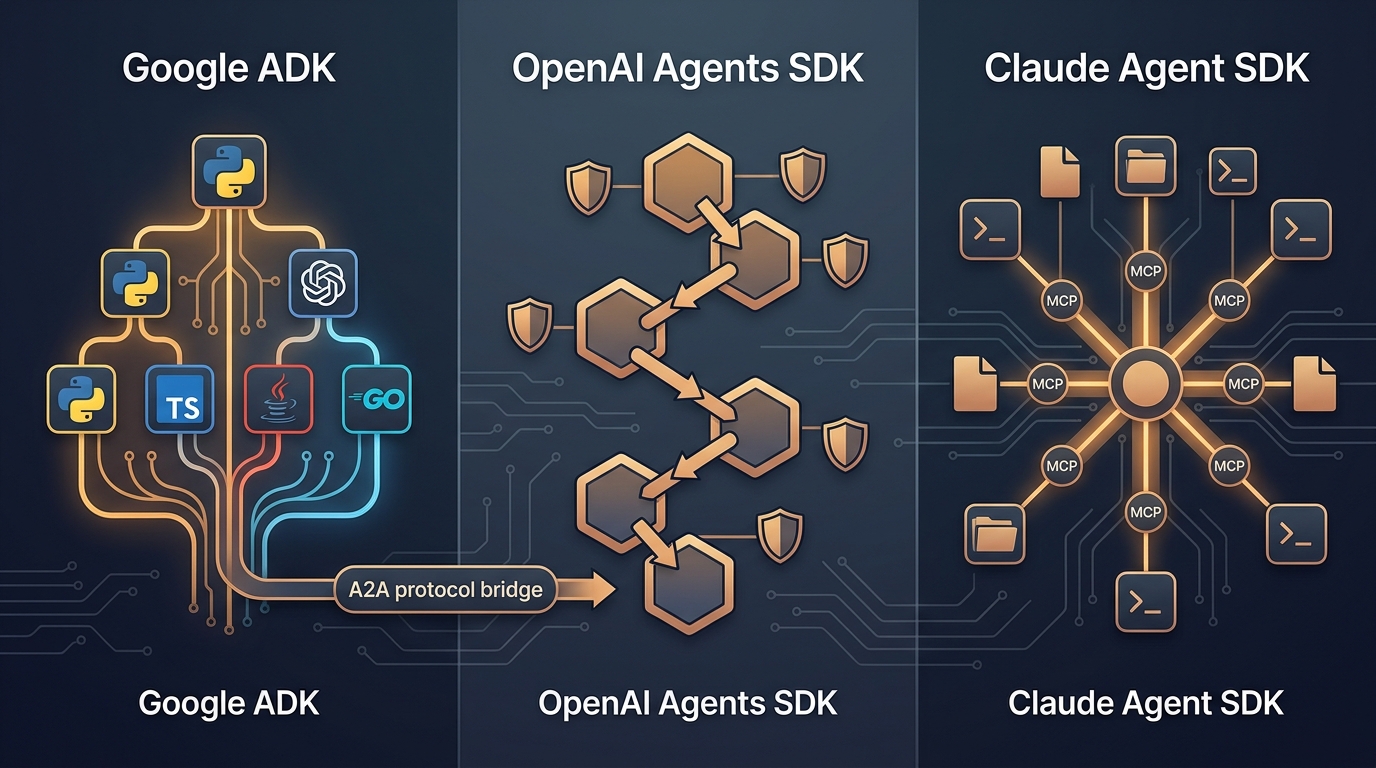
Google ADK vs OpenAI vs Claude Agent SDK: The 2026 Three-Way Comparison
Google's ADK 2.0 ships graph workflows in four languages with native A2A. OpenAI added sandbox execution and three-tier guardrails. Claude offers the deepest MCP integration in the ecosystem. We built the same multi-step agent across all three — here's how they compare, where each one wins, and what you'll regret picking.

Mem0 vs Zep vs LangMem: Which Memory Tool Wins?
Mem0 locks graph queries behind $249/mo. Zep killed Community Edition. LangMem is free but LangGraph-only. Which one actually belongs in your stack?