The Four-Layer Agent Infrastructure Stack: Where the Moat Actually Lives in 2026
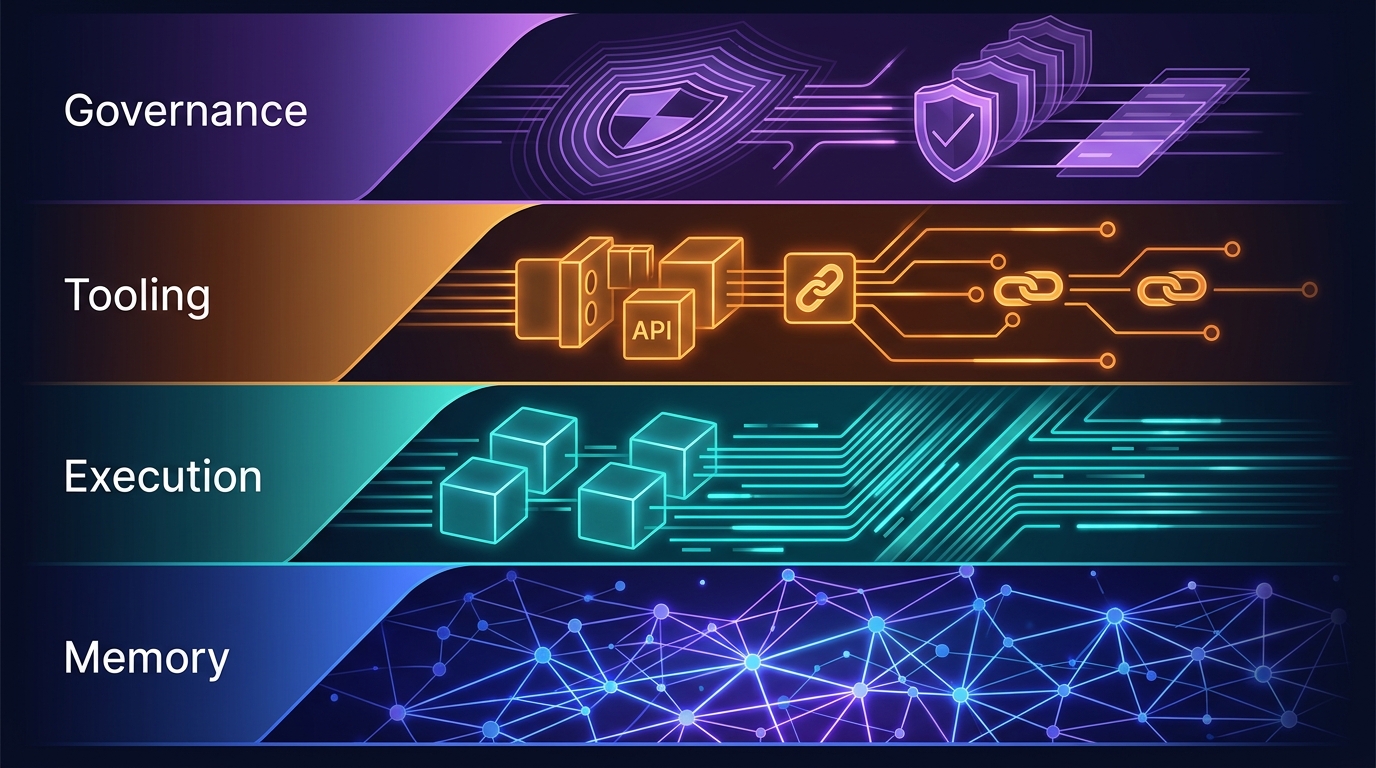
A generation of agent startups will get commoditized. The ones that survive own one of four stateful layers: Memory, Execution, Tooling, or Governance. Here's how to tell the difference between a moat and glue code.
The split nobody wanted to call in public is finally happening in private.
We’ve spent the last six months talking to teams shipping agents at scale — at fintechs processing claims, at logistics companies routing shipments, at enterprises where a single agent hallucination can trigger a six-figure compliance event. Every conversation eventually lands on the same question: which parts of the stack are actually worth building, and which are getting commoditized before the Series B closes?
The answer isn’t “everything gets commoditized by the hyperscalers.” It’s more specific — and more interesting.
The agent infrastructure market is splitting into four layers. Two of them are moats. Two of them are glue code. The difference comes down to a single property: whether the service gets more valuable the longer a customer uses it.
Why Traditional Cloud Primitives Break for Agents
Traditional cloud infrastructure was built for stateless, immutable workloads. A request arrives, gets processed, goes out. Containers, serverless functions, session-based auth — all designed around this model.
Agents don’t work this way.
An agent maintains persistent context across sessions. It takes actions with irreversible consequences. It delegates to sub-agents in multi-hop chains. It needs authorization, auditing, and governance for non-human identities at every step. None of these primitives exist in the standard cloud stack.
The numbers tell the story. PwC reports 79% of companies are actively adopting AI agents, and 88% plan to increase AI budgets. Yet only 2% have deployed agents at scale, according to Capgemini. The bottleneck isn’t model quality — models are good enough. KPMG found that 65% of IT leaders cite system complexity as their top deployment barrier.
As we wrote in our analysis of the infrastructure gap behind the 88% pilot failure rate, the problem isn’t that teams can’t build demos. It’s that the infrastructure for running agents in production doesn’t exist in the standard toolbox.
The Four Layers, Ranked
TGVP’s analysis of 100+ AI infrastructure founders identifies the four layers that agents actually need — and makes a critical distinction between stateful services and glue code. Here’s how each layer breaks down, ordered from strongest moat to weakest.
1. Memory — Strongest Moat
Agents need persistent, structured context that survives restarts and grows over time. Not vector search over chat logs. Not stuffing 200 messages into a context window. Real memory: semantic knowledge graphs that accumulate institutional knowledge across interactions, user preferences that compound, facts that get corrected without retraining.
This is fundamentally a stateful problem. The longer an agent runs on a memory platform, the more institutional knowledge accumulates. Migrating away means starting from zero.
Companies like Letta (from the Berkeley Sky Computing Lab that produced Databricks and Anyscale) are building dedicated agent runtimes where memory is a first-class primitive, not a bolted-on vector database. Mem0 and Zep compete in the memory-as-a-service space — a market we’ve analyzed in depth before.
DRAM pricing is projected to rise through 2026. As memory bandwidth becomes the binding constraint across the AI stack, platforms that efficiently manage persistent agent state gain a structural cost advantage. The economics of memory make statefulness more valuable over time, not less.
2. Governance — Strong Moat
Agents are non-human identities. They make API calls, move money, modify databases, and send emails — all without a human in the loop for each action. Traditional IAM was not designed for this.
Agent governance requires continuous, probabilistic authorization with rigorous audit trails. You can’t just check permissions at the start of a session. You need to verify that every tool call, every sub-agent delegation, every data read is authorized — and log it all in a way that survives a SOC 2 audit.
Startups like Astrix Security are building governance platforms specifically for non-human identities. The moat works the same way as memory: the longer an enterprise runs agent authorization through a governance platform, the more policy logic, delegation chains, and audit history become embedded. Switching costs grow with every agent deployment.
We covered the governance layer in detail in our deep dive on AI agent governance and the CISA warnings about agent security. The regulator tailwind alone makes this layer defensible.
3. Execution — Emerging Moat
Sandboxed compute environments that launch in milliseconds, support parallel execution paths, and provide fork-and-snapshot semantics. This is where agents actually run code.
Daytona raised a $24M Series A in February 2026, pivoting from dev environments to agent execution infrastructure. E2B and Modal compete in the same space with different execution models — Modal optimized for Python ML workloads, E2B targeting general-purpose sandboxing.
Execution platforms sit somewhere between moat and commoditization. Container orchestration is a solved problem. But sandboxes designed for agent workloads — sub-second cold starts, state snapshotting, GPU passthrough, network isolation — are genuinely new primitives.
The execution layer benefits from a hardware tailwind: GPU utilization is increasingly bottlenecked by memory bandwidth, which makes efficient sandbox orchestration a real differentiator. We covered the isolation side of this in our deep dive on Firecracker, gVisor, and microVM architectures for agent sandboxing.
4. Tooling (Protocols & Connectors) — Glue Code
The Model Context Protocol (MCP) has become the dominant standard for agent-tool integration, with 97M+ monthly SDK downloads and backing from OpenAI, Google, and Microsoft. MCP wins. The question isn’t whether it’s the right protocol — it is — but whether anyone builds a durable business on top of it.
Connector catalogs and framework wrappers are vulnerable to commoditization. They don’t get more valuable the longer a customer uses them. A Salesforce connector today is interchangeable with a Salesforce connector next year. MCP makes this worse, not better, because it standardizes the interface layer and accelerates the race to zero for integration middleware.
This isn’t to say tooling isn’t valuable — it’s critical infrastructure. But it’s infrastructure without a moat. The value accrues to the protocol, not to individual vendors. Our protocol stack analysis makes the same point: protocols win, protocol wrappers lose.
The Signal: Stateful Services Make the Moat
The pattern is consistent across all four layers: the moat is proportional to how much state a service accumulates per customer.
Memory platforms accumulate knowledge graphs. Governance platforms accumulate policy logic and audit history. Execution platforms accumulate environment configurations and optimization profiles. Connector platforms accumulate… a list of API endpoints.
This maps cleanly onto the infrastructure landscape we’ve been tracking all year. The frameworks market is fragmenting as LangGraph, CrewAI, AutoGen/AG2, and the OpenAI/Claude Agent SDKs compete for developer mindshare. But frameworks are the thinnest layer — the switching costs are measured in developer hours, not data gravity.
The real infrastructure money in 2026 is flowing into stateful layers: memory, governance, execution. The glue code layer — frameworks, connectors, orchestration middleware — gets absorbed by platforms or replaced by protocols.
What This Means If You’re Building an Agent Stack
You need all four layers. But you should build moat-level layers yourself (or buy from vendors with genuine lock-in) and treat the glue-code layers as interchangeable.
Memory: Don’t roll your own vector database. Pick a platform that accumulates institutional knowledge — Letta, Mem0, or Zep — and accept that switching will be expensive. That’s the point.
Governance: Start with the audit trail. Every tool call, every sub-agent delegation, every data access. If you can’t produce a SOC 2 artifact for an agent action six months after it happened, you don’t have governance.
Execution: Use sandboxed environments, not shared containers. Firecracker microVMs or E2B/Modal sandboxes. One agent, one sandbox, one lifecycle. The security model isn’t optional.
Tooling: Adopt MCP. Don’t over-invest in custom connectors. The protocol will commoditize everything above it, and that’s a good thing — it frees you to spend engineering time on the layers that actually differentiate.
The Market in Three Sentences
Models are commoditizing. Protocols are standardizing. The only durable advantage is state that compounds over time.
If your agent infrastructure product doesn’t get more valuable the longer a customer uses it, you’re selling glue code — and the clock is ticking. If it does, you’re building the infrastructure layer that the 98% of enterprises still stuck in pilot will eventually need to buy.
That’s the bet. Everything else is table stakes.
Related Posts

The Context Budget Is Your Agent's Real Architecture — Everything Else Is Plumbing
Every architectural decision in your agent system — subagent delegation, memory, tool design, model choice — boils down to managing a single finite resource: the context window. Here's how to treat the context budget as a first-class constraint, with concrete patterns that ship.

The Agent Pricing Crisis: Nobody Knows How to Bill for Intelligence
Anthropic paused its Agent SDK billing overhaul on launch day. Salesforce ditched $2/conversation for Flex Credits. Per-seat SaaS is dying, and agent-native pricing remains an unsolved equation. Here's why — and what comes next.
Agent Sandboxing: Firecracker, gVisor & Production Isolation
Docker containers aren't enough for AI agents. We break down Firecracker microVMs, gVisor, and Kata Containers — with code, benchmarks, and a decision framework for production.