The Agent Durability Gap: Why Production Agents Fail (and How to Fix It)

Agents that work in demos fail in production. The gap isn't model quality — it's infrastructure. Durability, checkpointing, and recovery are the missing layers.
The Agent Durability Gap: Why Production Agents Fail (and How to Fix It)
Most teams that ship AI agents to production hit the same wall at roughly step three: the demo works, the pilot works, and then the agent runs for three hours, calls fourteen tools, hits a rate limit on step eleven, and silently dies.
The post-mortem never blames the model. The model was fine at step ten. The problem was that the infrastructure around the model had no idea what to do when something went wrong three hours into a long-running task.
We’ve now helped dozens of teams move agent prototypes to production systems. The pattern is universal: frameworks are optimized for reasoning, not durability. And reasoning without durability is just expensive demo software.
This post breaks down what the durability gap actually is, why it emerges in every framework we’ve tested, and the concrete architectural patterns that close it.
The Durability Gap Defined
Here’s the gap in one sentence: agent frameworks give you a way to describe what an agent should do, but almost nothing to guarantee it actually gets done when the environment is hostile.
Compare this to the rest of software engineering:
- CRUD APIs: Stateless, idempotent, under your control. Failure means retry the request.
- Payment processing: Built on decades of durable execution. If Stripe’s callback drops, you reconcile. If your process crashes, Stripe still processed it.
- Data pipelines: Airflow, Dagster, Temporal — the whole point of these tools is that a task can fail mid-flight and resume, not restart.
Agents sit at the intersection of all three failure modes: long-running stateful work, external API dependency, and non-deterministic model outputs. Yet the default deployment pattern for most agents is still a Flask process running on a single container with no restart guarantees.
Why Every Framework Is Built This Way
To understand the gap, you need to understand the incentive structure of the framework ecosystem.
Frameworks optimize for developer experience
LangGraph, CrewAI, AutoGen, the OpenAI Agents SDK — all of them made excellent decisions about how to make agents easier to write. Directed graphs, role-based agents, tool decorators, structured output. These are all abstractions on top of the reasoning layer.
But reasoning and durability are orthogonal concerns. You can have a beautiful state graph and still lose all state when the process OOMs. You can have elegant tool decorators and still have no way to retry a tool call that returned a 503 three steps ago.
Durability is boring infrastructure work
Adding a production-grade checkpointer to LangGraph means running Postgres, managing connection pools, handling concurrent writes, and surviving schema migrations. Adding durable execution to CrewAI means adopting Temporal or DBOS or Inngest — whole separate systems.
Most teams don’t want to do this work. Framework vendors know this. So they ship MemorySaver (in-memory checkpointer, great for notebooks, useless in production) and call it a day.
The failure mode is silent
An agent that fails silently is the worst kind of failure. It doesn’t throw. It doesn’t 500. It just stops. The user thinks the agent is “thinking.” The logs show nothing abnormal. The agent loop hit an edge case, the LLM returned malformed JSON, the parser threw, and the Python process swallowed it because nobody put a try/except around the tool execution.
This is why “95% reliable per step” agents are actually 40% reliable end-to-end. If an agent has 14 steps, and each step is 95% reliable: 0.95^14 = 0.49. Your agent is a coin flip.
That’s not a model problem. That’s a durability problem.
What Production Durability Actually Looks Like
The teams that ship agents that stay up don’t do it by writing better prompts. They do it by treating agents as distributed systems first, and reasoning systems second.
Pattern 1: Durable execution as the outer layer
The most effective pattern we’ve seen is Temporal (or equivalent) as the outer orchestration layer, framework-specific reasoning as the inner layer.
Temporal is a durable execution engine. You write code that looks like a regular sequential function, but Temporal intercepts every external call and persists state to a database. If the worker crashes, Temporal replays the function on a new worker and it continues from where it left off.
In this pattern:
- The workflow is the agent’s lifecycle — durable, long-running, crash-proof.
- Activities are LLM calls, tool invocations, database writes. Each is independently retryable.
- LangGraph (or CrewAI, etc.) runs inside an activity — it decides what to do, and Temporal ensures it actually happens.
This isn’t theoretical. Temporal just announced at Replay 2026 (May 2026) a suite of agent-specific primitives: Workflow Streams for real-time token delivery, Serverless Workers for automatic scaling, Standalone Activities for lightweight durable jobs, and first-class integrations with Google’s ADK and the OpenAI Agents SDK sandbox (Temporal Replay 2026 announcements).
These announcements aren’t incremental. They signal that the durable execution industry recognizes agents as a first-class workload — and is building infrastructure to match.
Pattern 2: Checkpointers as the minimum bar
If Temporal is too heavy for your use case, the absolute minimum for any production agent is a persistent checkpointer.
LangGraph ships with PostgresSaver, which persists the graph state to Postgres after each step. This gives you:
- Recovery from process restarts
- Human-in-the-loop via thread resumption
- Replay and debugging of agent sessions
But there’s a catch: PostgresSaver only preserves state. It doesn’t give you automatic retries, saga compensation, or guaranteed delivery. If your LLM call times out, PostgresSaver won’t retry it. If your tool call returns a 503, Postgres will happily save the error state and move on.
This is where teams get stuck: they think “checkpointing means durability.” It doesn’t. Checkpointing means you can resume. Durability means you don’t have to.
Pattern 3: Idempotent tool calls
Every tool in your agent should be idempotent. If the agent calls create_ticket twice (because the first call succeeded but the response was lost in a network error), you get two tickets.
The fix is dead simple: generate a UUID at the workflow level, pass it as an idempotency key to every tool, and have the tool check for existing results before executing.
This is basic distributed systems hygiene. But it’s missing from almost every agent tutorial we’ve seen.
Pattern 4: Compensating actions (sagas)
A production agent doesn’t just plan forward — it undoes backward. If your agent creates a database record, charges a customer, sends an email, and then fails on step four, it needs to undo the first three steps.
Temporal models this as a saga. Each workflow step has a corresponding compensation activity. If the workflow fails or a human cancels it, compensations run in reverse order.
LangGraph doesn’t do this natively. Neither does CrewAI. This is the gap between “framework for reasoning” and “engineering for reliability.”
A Concrete Architecture
Here’s the reference architecture we’d recommend for any agent system that needs to run autonomously for more than a few minutes:
┌─────────────────────────────────────────────┐
│              Temporal Workflow               │
│  (durable orchestration, crash recovery)     │
│                                              │
│  ┌────────────────────────────────━━━━━━┐   │
│  │       Activity: LLM Plan & Route      │   │
│  │  (invoke LangGraph as a library)       │   │
│  │  - PostgresSaver for graph state       │   │
│  │  - Max turns enforced                  │   │
│  │  - Structured JSON output              │   │
│  └────────────────────────────────━━━━━━┘   │
│                                              │
│  ┌────────────────────────────────━━━━━━┐   │
│  │       Activity: Tool Execution         │   │
│  │  - Idempotency keys                    │   │
│  │  - Exponential backoff retry           │   │
│  │  - Circuit breaker on external APIs     │   │
│  └────────────────────────────────━━━━━━┘   │
│                                              │
│  ┌────────────────────────────────━━━━━━┐   │
│  │       Signal Block: Human Approval     │   │
│  │  (pauses for hours/days, zero cost)    │   │
│  └────────────────────────────────━━━━━━┘   │
│                                              │
│  ┌────────────────────────────────━━━━━━┐   │
│  │    Activity: Compensation (on fail)    │   │
│  └────────────────────────────────━━━━━━┘   │
└─────────────────────────────────────────────┘
The key insight: LangGraph is a library, not a runtime. It handles the reasoning graph. Temporal (or an equivalent durable execution engine) handles the reliability guarantees. You don’t choose one or the other — you layer them.
What the Framework Vendors Should Do Next
We’re not blaming framework authors. They solved the problems that were most urgent to the early adopter community. But the durability gap is now the #1 blocker to getting agents out of pilot hell, and it’s a problem the whole ecosystem needs to address.
Here’s what we want to see:
-
Production checkpointers as the default.
MemorySavershould be labeled “for development only.” PostgresSaver (or an SQLite equivalent for simple cases) should be the default in every tutorial. -
Built-in retry semantics. Frameworks should have standard patterns for “retry this step if it fails with a transient error.” Right now you’re writing your own retry decorators in every project.
-
Idempotency baked into tool definitions. The
@tooldecorator should accept an idempotency key parameter and handle deduplication transparently. -
Event sourcing for agent state. Instead of “save the current state after this step,” frameworks should emit events for every tool call, LLM output, and user interaction. Replay is the ultimate debug tool.
-
First-class human-in-the-loop. Not as a hack, but as a primitive: pause, wait for signal, resume. Temporal does this with signals; frameworks should standardize around the same model.
The Hard Truth About Agent Infrastructure
We’ve spent the last eighteen months watching the AI infrastructure stack evolve from inference optimization to full agent orchestration. The pattern is clear: every new layer of AI capability creates a new layer of infrastructure debt.
- Reasoning models created context windows → context windows required vector databases.
- Tool calling created MCP → MCP required gateway infrastructure.
- Multi-agent orchestration created coordination complexity → coordination requires durable execution.
Each time, the teams that treated the infrastructure layer as a first-class concern shipped. The teams that tried to duct-tape reasoning models to HTTP endpoints didn’t.
Agents are distributed systems wearing an LLM hat. If you’re building production agent infrastructure, start with that truth and work backward.
For the broader infrastructure landscape that agents operate within, see our AI Infrastructure Stack 2026 Edition. If you’re dealing with the specific challenges of multiple coordinating agents, our Multi-Agent Orchestration Infrastructure guide covers the operational patterns we’ve seen work in production. And for the fundamental differences between serving LLMs and serving agents, read Agent Infrastructure: What’s Different from LLM Serving.
We build infrastructure for AI agents at Turion. If you’re wrestling with agent durability in production, talk to us.
Related Posts

Agent Infrastructure: What's Different from LLM Serving
Serving agents isn't the same as serving LLMs. Different concurrency models, different observability, different failure modes. A tour of what production agent infrastructure actually looks like.
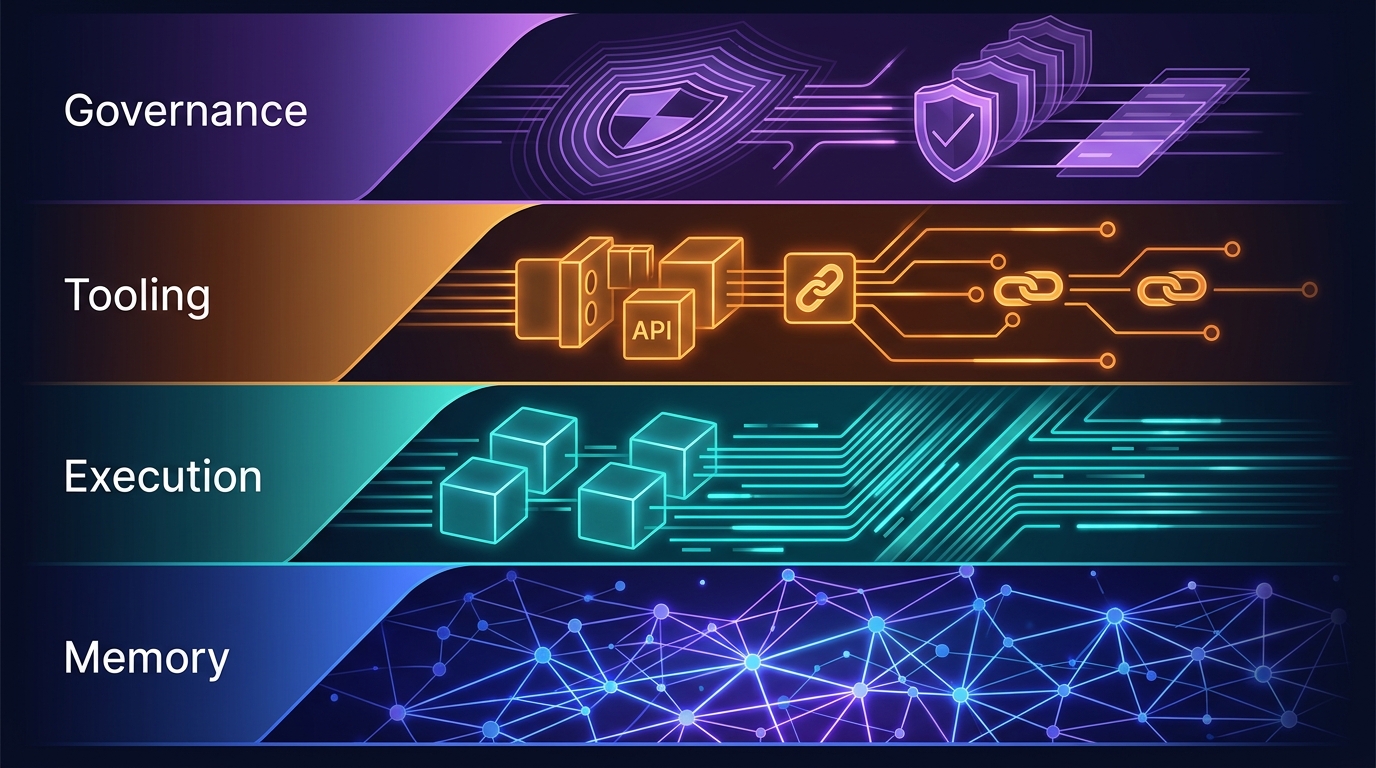
The Four-Layer Agent Infrastructure Stack: Where the Moat Actually Lives in 2026
A generation of agent startups will get commoditized. The ones that survive own one of four stateful layers: Memory, Execution, Tooling, or Governance. Here's how to tell the difference between a moat and glue code.

Building Production AI Agents: The Complete Guide from Prototype to Deployment
A comprehensive 2500+ word end-to-end guide covering everything you need to take AI agents from experimental prototypes to reliable production systems, including architecture patterns, reliability engineering, monitoring, and scaling strategies