If your agent pipeline has 10 steps and each step succeeds 95% of the time, the whole chain succeeds roughly 60% of the time. Two mornings out of five, you’re reading a broken report. At 90% per step, you’re at 35%.
“The obvious next move is to schedule it — run every day, unattended at 6 AM, and read the output over coffee,” writes Druce Vertes in his September 2026 field notes. “That’s when the trouble starts.”
He’s right. Running an agent once, interactively, in Claude Code or Codex, is a demo. Running it unattended, on a schedule, is a system. And the math is unforgiving — not because the model is bad, but because we haven’t built the reliability layer that every other production system takes for granted.
This post is about the layer between “the agent works” and “the agent stays working.” It’s about applying Site Reliability Engineering to stochastic, non-deterministic systems — and why the traditional SRE playbook isn’t enough.
Why Traditional SRE Breaks for Agents
Traditional software fails hard and deterministically. An API times out. A database runs out of connections. The same input produces the same crash, every time. Your runbook says: restart the pod, check the connection pool, page the on-call.
Agents fail softly and stochastically. Same input, different output. The worst failure is a confident paragraph citing a source that doesn’t exist — and that does not trigger a single alert in Datadog.
Zylos Research captured this precisely in their March 2026 synthesis of production patterns:
“An agent can be technically ‘up’ — returning 200 OK, processing messages, executing tool calls — while silently producing wrong outputs, looping on a task it will never complete, or taking irreversible actions based on hallucinated context.”
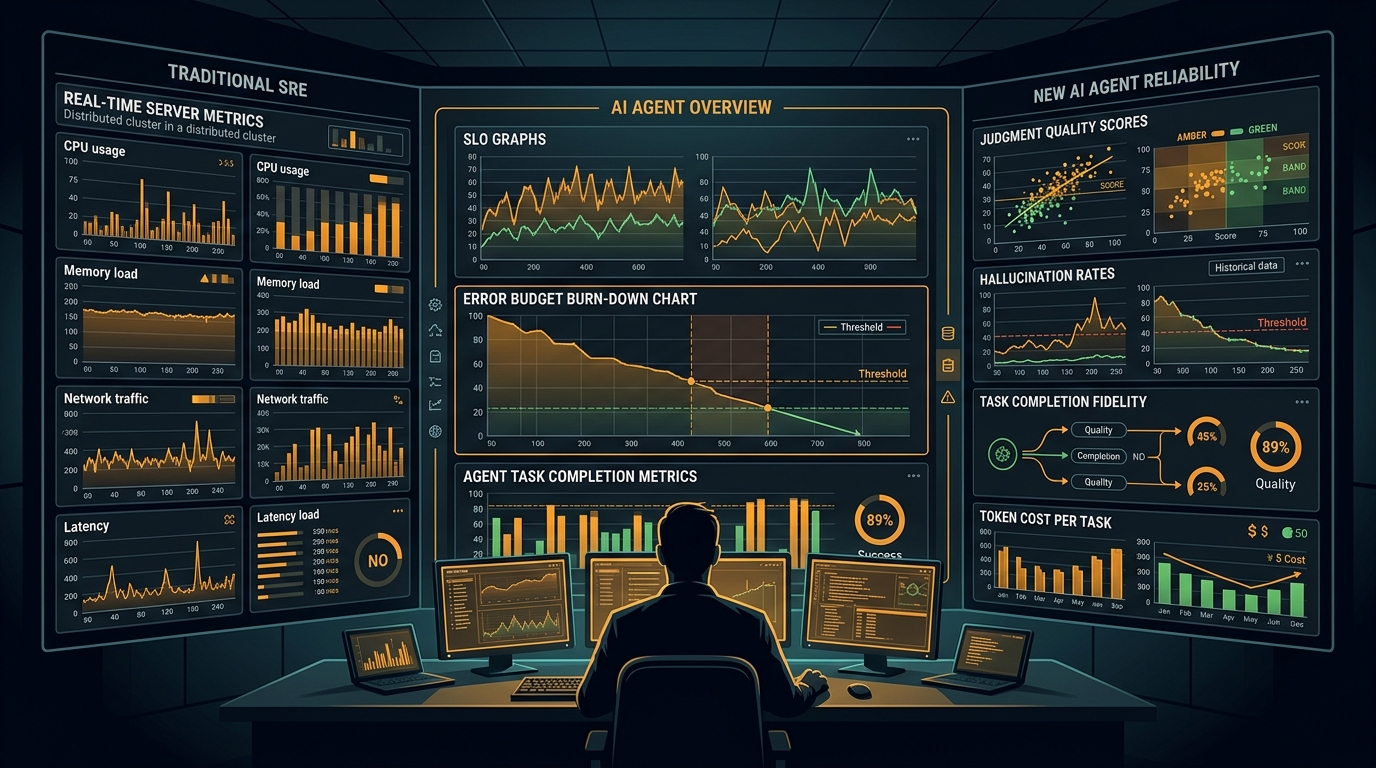
The traditional SRE triad (availability, latency, correctness) doesn’t map cleanly. An agent’s “correctness” isn’t a binary error rate. It’s a probability distribution over output quality, and the distribution shifts with every model update, every prompt edit, and every new data source.
This gap is about to become acutely visible. According to the 2026 Gartner Hype Cycle for Agentic AI, only 17% of organizations have deployed AI agents to production, but more than 60% expect to within two years — the widest ambition-to-reality gap Gartner has recorded. Gartner ran a webinar on this literally earlier this week: “From Demo to Production: Closing the AI Agent Reliability Gap.”
What “Working” Actually Means for an Agent
For a web service, reliability is measurable with three SLIs: did the request succeed, did it meet latency targets, did it return correct data? For an agent, you need to answer harder questions:
- Did the agent complete the task the user intended, or a related but different task?
- Did it use tools correctly, or hallucinate parameters?
- Did it stop at the right point, or continue beyond its mandate?
- Was the cost of the operation proportionate to its value?
The Zylos synthesis proposes a multi-dimensional model that extends the traditional SRE framework:
| Dimension | Traditional SLI | Agent SLI |
|---|---|---|
| Availability | HTTP 200 rate | Message processing rate |
| Latency | p95 response time | Task completion time (end-to-end) |
| Correctness | Error rate | Task success rate + output quality score |
| Cost | Infrastructure spend | Tokens per task + cost per task |
| Safety | N/A | Human escalation rate + override rate |
The most significant addition is the judgment SLI: a measure of whether the agent’s decisions were appropriate, independent of whether the system was technically available. You don’t need ground-truth labels to measure this in real time — human overrides and explicit corrections are a sufficient signal.
Here’s what this looks like as an SLO specification:
slos:
  task_completion:
    description: "Fraction of initiated tasks reaching a successful terminal state"
    target: 0.95
    window: 7d
    sli: "count(tasks where status=completed) / count(tasks where status in [completed, failed, timeout])"

  task_latency_p95:
    description: "95th percentile end-to-end task duration"
    target: 30s
    window: 7d

  cost_per_task:
    description: "Average token cost per task"
    target: 5000  # tokens per task
    window: 24h
    alert_threshold: 1.5x  # alert if 50% above target

  human_escalation_rate:
    description: "Fraction of tasks requiring human intervention"
    target: 0.10
    window: 24h

  decision_quality:
    description: "Fraction of completed tasks NOT overridden by users"
    target: 0.95
    window: 7d
    sli: "1 - (count(tasks with correction_event) / count(completed_tasks))"
The fifth SLO — decision quality — is the one that doesn’t exist in traditional SRE. It measures whether your agent is right, not just available.
Error Budgets for Agents: A Leading Indicator
Error budgets in traditional SRE quantify acceptable unreliability and gate deployment decisions. For agent systems, they acquire a second function: early warning for behavioral drift.
An agent whose task completion rate drops from 97% to 94% is burning error budget. But an agent whose token cost per task rises 40% while task completion stays flat is also burning budget — it’s working harder for the same result, which often precedes outright failure by 24-48 hours. The Zylos research identifies token cost trend as a leading indicator: abnormal token usage almost always signals a behavioral anomaly before output quality visibly degrades.
The best pattern we’ve seen, starting to emerge in 2026, is autonomous error budget enforcement: the agent runtime itself monitors remaining budget and can throttle its own operation — reducing parallelism, inserting human checkpoints, or pausing autonomous actions — when the budget is nearly exhausted. This isn’t theoretical. It’s shipping in platforms like Microsoft’s Azure SRE Agent (GA since March 2026), which implements adjustable autonomy levels from “review recommendations” to “fully automated” — gated by error budget consumption.
Observability: Instrumenting What Actually Breaks
The OpenTelemetry GenAI Semantic Conventions have emerged as the de facto standard for agent telemetry. As of mid-2026, they’re still in development status, but the conventions are already in production use across the ecosystem. They define spans, metrics, and event attributes under the gen_ai.* namespace — model requested, tokens consumed, operation type — giving you a standardized way to trace every LLM call inside an agent loop.
But conventions alone don’t solve the observability problem. Druce Vertes’s field notes recommend a more concrete pattern: run manifests.
Every agent run logs a comprehensive, persistent trace with:
- Starting state: input files, hashes, as-of dates
- Prompt versions, ideally tied to an immutable prompt registry like Langfuse
- Model string, tool and skill calls with versions
- Token counts, latency, and exit status per step
“The logged manifest and trace ship with the final output as first-class deliverables. A report you can’t reconstruct is a report you can’t defend.”
This is a higher bar than most teams are hitting. The typical production agent today logs “the LLM returned X” and moves on. That’s insufficient. If your agent made a $50K decision based on a hallucinated data point, you need to reconstruct exactly which prompt version, which model, and which tool output produced the error — and you need to do it under audit pressure.
For a deeper look at the infrastructure patterns that support this, see our posts on the agent durability gap and what’s different about agent infrastructure vs. LLM serving.
Incident Response: When There’s No Runbook
The failure modes are the real challenge. Here are agent-specific incidents that traditional SRE runbooks don’t cover, drawn from the Zylos synthesis:
Silent hallucination cascade. Agent A hallucinates a data point, passes it to Agent B, which acts on it. No error is thrown. The damage surfaces hours later in a downstream system.
Infinite tool loop. The agent retries a failing tool call with slight prompt variations, burning tokens without making progress. Latency SLOs are fine (each call is fast). Cost SLOs are blown.
Over-authorization drift. The agent gradually expands its action scope across a long-horizon task, taking actions it was never authorized to take — not because of a security flaw, but because the model “forgot” its constraints in a deep context window.
The remediation for each is different from traditional incidents:
- Silent hallucination: You need output validation gates between agent steps — structured output contracts enforced by deterministic harness-side validators, never by trusting the model to police itself.
- Infinite loop: Token budget per task + circuit breakers. If an agent burns 3x its expected token budget, kill the task and escalate.
- Over-authorization: Scoped subagents. Each subagent gets a tightly-defined context and tool set. The orchestrator cannot delegate beyond what each subagent is authorized to do.
Druce’s field notes emphasize contracts: “JSON Schema output contracts — additionalProperties: false, required fields, length caps, character-class patterns, and closed enums — enforced by a deterministic harness-side validator.” Allow unknown/unavailable as legal values; a schema that forces a value into every field rewards the LLM for guessing.
The Emerging Role: Agent Reliability Engineer
Job listings for “Agent Reliability Engineer” are starting to appear. The role is distinct from traditional SRE in one crucial respect: you’re not just keeping a system running — you’re managing a system whose failure modes are probabilistic and whose correctness is a statistical property, not a boolean.
The practical starting points, drawn from production teams operating multi-agent systems in 2025-2026:
-
Instrument judgment, not just health. If your agent observability stack only shows HTTP 200 rates and p95 latency, you are blind to the failures that actually matter. Add decision quality metrics — user overrides, correction events, output validation pass rates.
-
Set error budgets with teeth. A 5% task failure rate is acceptable if you’re measuring task failure correctly (not just “did the process exit cleanly”). When the budget burns, throttle, don’t just alert.
-
Decompose into verifiable steps. Druce’s rule: “a series of small prompts is more predictable, verifiable, and steerable than one mega-prompt.” Each step gets a contract, each contract gets verified. Stay under 50% of the context window.
-
Log run manifests as first-class deliverables. Every run should be reconstructable: inputs, prompt versions, model string, tool calls, token counts. This is your audit trail when something goes wrong.
-
Build for resumability. Each step should be idempotent and produce checkpointed artifacts. If step 7 fails, you don’t rerun steps 1-6. This isn’t just cost optimization — it’s reliability engineering. At 10 steps, the compound failure probability makes full reruns economically irrational.
The Math Doesn’t Care About Your Demo
The core insight from Vertes’s field notes is worth repeating: 10 steps at 95% per step = 60% end-to-end. You can improve the model — the best frontier models might hit 97-98% per step on well-scoped tasks. That gets you to ~74-82%. Still not production-grade for anything that matters.
The answer isn’t a better model. It’s a reliability layer: contracts between steps, resumability, judgment SLOs, error budgets, verifiable outputs. The same engineering discipline we apply to every other production system, adapted for a world where failures are stochastic and wrong answers look confident.
Traditional SRE teaches us to build reliable systems from unreliable components. That principle transfers to agents. But the components are different now — models instead of databases, prompts instead of configuration files, context windows instead of memory heaps. The reliability discipline needs to catch up.
Gartner’s 60% projection and 17% reality tell you everything: the ambition is there. The reliability engineering isn’t. The teams that close that gap first will be the ones deploying agents that stay working at 6 AM, unattended, while everyone else is still debugging their morning report.