The Week the Agent Bill Came Due: WWDC, SpaceX's $75B IPO, and Anthropic's Billing Split
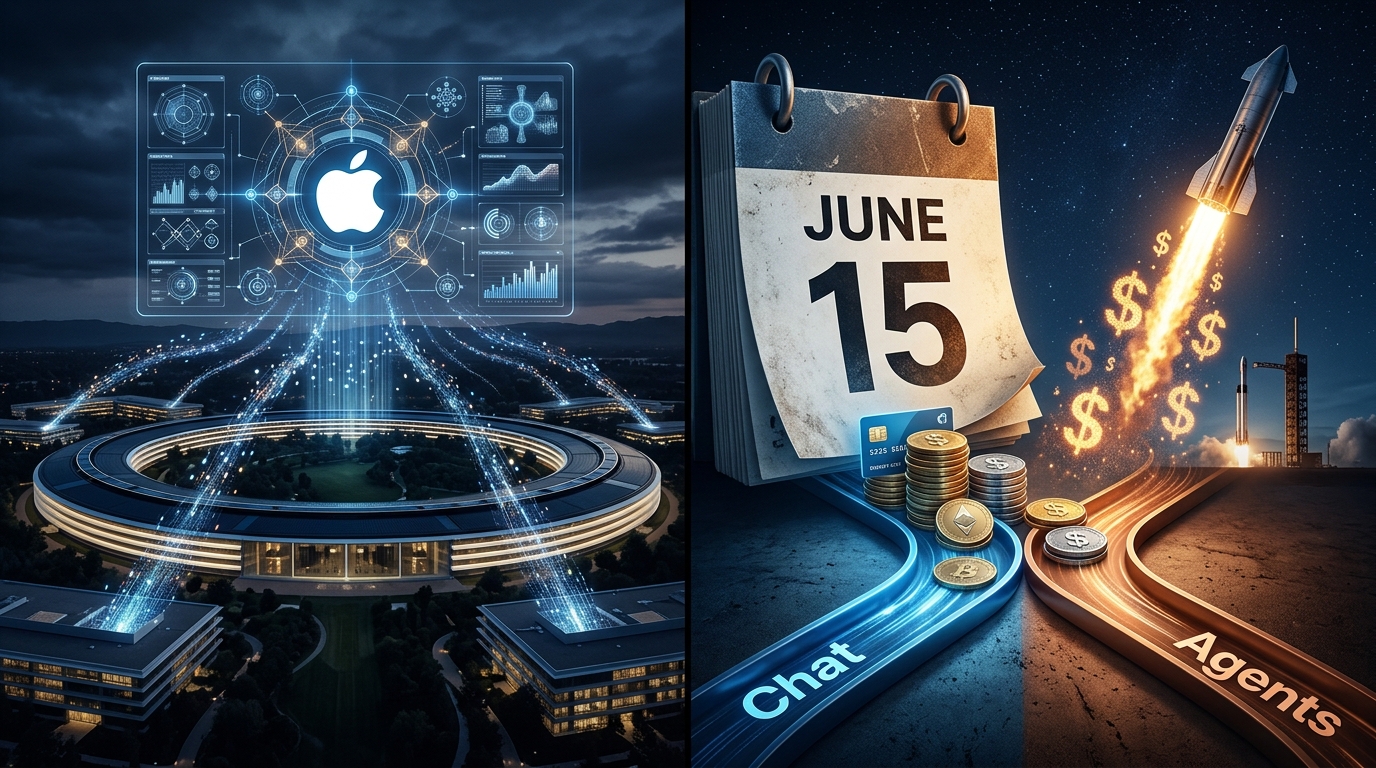
Apple put Claude on 2 billion iPhones. SpaceX raised $75B in the largest IPO in history. And Anthropic draws a line between 'chat' and 'agents' — starting tomorrow, June 15. Here's what the week that just reshaped the agent economy means for builders.
Last week was about platform launches. This week was about the bill. Literally.
In seven days, Apple handed Claude distribution to 2 billion devices, SpaceX priced the largest IPO in history at $75 billion, Mistral telegraphed a €3 billion raise, and — most consequentially for anyone shipping agent infrastructure — Anthropic finalized the billing architecture that separates “chat” from “agents” forever. That split goes live tomorrow, June 15.
If you build or pay for agent workloads, here’s what just happened and what you need to do about it.
Apple WWDC 2026: Claude Becomes an iPhone Citizen
Tim Cook’s final WWDC keynote as CEO delivered one thing that matters more than any model announcement: the Extensions system.
iOS 27, iPadOS 27, and macOS 27 will let users choose which AI model powers Apple Intelligence — ChatGPT, Google Gemini (default), or Anthropic’s Claude (TechCrunch). Select Claude, and you get Claude’s voice and persona for writing, complex questions, and cross-app tasks across the entire Apple ecosystem.
The rebuilt Siri itself runs on a custom 1.2-trillion-parameter Google Gemini model, housed in a standalone app with personal context access (emails, photos, files), on-screen awareness, and Dynamic Island integration (Apple Newsroom). iOS 27 Beta 1 shipped the same afternoon.
For agent builders, the Extensions system is the headline. Anthropic has never had a native consumer distribution channel — just an API, a web app, and developer tools. Now Claude is a first-class citizen on over 2 billion active Apple devices, shipping in September. This isn’t a partnership announcement. It’s a distribution event that rewrites Claude’s addressable market overnight.
The subtext: Google powers Siri under the hood, but Apple is giving users an off-ramp. That’s a remarkably honest acknowledgment that no single model vendor owns the interface layer — not even the one Apple built Siri on top of.
Anthropic’s June 15 Billing Split: The Agent Bill Comes Due
This is the most important infrastructure story of the week, and it hasn’t even happened yet. Tomorrow.
On June 15, 2026, Anthropic pulls the Claude Agent SDK, claude -p, Claude Code GitHub Actions, and third-party agent apps out of flat-rate subscription plans and into a separate monthly credit pool (Anthropic Support, Prove AI).
Here’s what that means in practice:
| Plan | Monthly Agent SDK Credit |
|---|---|
| Pro | $20 |
| Max (5 users) | $100 |
| Max (20 users) | $200 |
| Team (Standard) | $20/seat |
| Team (Premium) | $100/seat |
| Enterprise (Premium) | $200/seat |
Once the credit burns, usage continues at standard API rates through usage credits. If usage credits aren’t enabled, agent requests stop dead until the next monthly refresh. There is no rollover.
The structural shift is what matters. Anthropic is drawing a permanent billing line between two operating modes:
- Conversational: you talking to Claude directly (web, desktop, mobile, interactive Claude Code). Stays on subscription limits.
- Programmatic: Claude embedded in workflows, CI/CD, multi-agent pipelines, and third-party tooling. Now metered separately.
This isn’t a price hike — it’s a recognition that programmatic agent usage is a fundamentally different economic product than chat. One consumer burns tokens while thinking. The other burns tokens continuously, in loops, across hours, without a human watching. The subscription flat rate was always a subsidy. That subsidy ends tomorrow.
We flagged this shift in our May platform updates coverage. Now it’s live. If you have production agents running through subscription-auth Claude workflows, audit them today. Move shared production workloads to API keys with spend controls. Treat context management as a cost lever — every token of state you carry through an agent loop now has a transparent price.
For teams running enterprise TCO calculations, bake this into your model immediately. Anthropic’s metered agent pricing is the template. OpenAI, facing its own IPO roadshow and quarterly earnings pressure, will face the same gravitational pull.
SpaceX Raises $75B. Mistral Lines Up €3B. The IPO Floodgates Are Open.
On June 11, SpaceX priced 555.6 million shares at $135 each, raising $75 billion at a ~$1.77 trillion valuation — the largest IPO in history (CNBC, Reuters). The ticker SPCX debuted on Nasdaq June 12.
This matters for AI infrastructure because SpaceX acquired xAI earlier this year. The combined entity is now publicly traded, AI-exposed, and sitting on $75 billion in fresh capital. That capital will flow into compute, models, and — critically — the Grok ecosystem. It’s a third pole in the AI infrastructure race, alongside the Google/Anthropic axis and the Microsoft/OpenAI axis.
Meanwhile, French lab Mistral AI is in early discussions to raise roughly €3 billion ($3.5B) at a €20 billion valuation — nearly double its Series C valuation of €11.7 billion (TechCrunch). And OpenAI’s own IPO, filed confidentially June 8, is targeting a September debut north of $850 billion (New York Times).
The pattern: every major AI lab is either public, going public, or raising at public-market scale. This changes pricing behavior. Public companies answer to quarterly earnings calls. The era of “growth at all costs” model pricing is ending. The era of metered, margin-conscious agent economics is here.
The Regulatory Clock: EU AI Act 49 Days, Colorado 16 Days
Two deadlines are closer than most teams realize:
-
EU AI Act — August 2, 2026. GPAI enforcement powers and Article 50 transparency obligations activate. High-risk AI systems in employment, education, critical infrastructure, financial services, law enforcement, and migration face full compliance requirements. Fines reach €35 million or 7% of global annual turnover (Build Fast with AI).
-
Colorado AI Act — June 30, 2026. Developers and deployers of high-risk AI systems serving Colorado residents must have risk management programs, annual impact assessments, and disclosure obligations in place. Sixteen days.
If you’re deploying agents into regulated verticals — and our enterprise agent platforms comparison shows that’s where the money is flowing — both deadlines are inside your current sprint cycle.
What This Means for Your Stack
Three takeaways:
1. The chat/agent billing wedge is now permanent. Anthropic is first, but every model vendor charging flat-rate subscriptions will follow. Programmatic agent usage burns orders of magnitude more tokens than chat. The economics don’t work any other way. Build cost models assuming metered agent pricing is the baseline, not the exception.
2. Distribution is settling into a three-way oligopoly. Apple (2B devices, model-agnostic), Google (Search + Android), and Microsoft (enterprise + GitHub + Azure). Claude on iOS completes the map. Your agents will reach users through one of these three pipes. Pick your protocol bets accordingly.
3. Public-market discipline is arriving. SpaceX ($75B IPO), OpenAI ($850B+ target), Anthropic (profitable quarter, likely next). The pricing environment of 2024–2025 — where token costs dropped 10x in 18 months — is behind us. The next phase is margin protection. Lock in your infrastructure assumptions now, not when the earnings calls start.
The June monthly update we published this week covers the broader platform landscape (read it here). But if there’s one action item from this week: check your Anthropic billing configuration before tomorrow. The agent bill is here.
Related Posts

The Week AI Went Agent-Native: Google I/O, Anthropic's Profit, and OpenAI's IPO
Google replaced the search box with 24/7 information agents. Anthropic hit its first profit and hired Karpathy. OpenAI filed for IPO. Here's what the biggest week in AI history means for the agent stack.

AI Agent Platforms: May 2026 Updates
OpenAI sandboxing, Anthropic Opus 4.7, Claude Code enterprise — what changed in May 2026 and which updates matter for your agent stack?

What OpenAI, Anthropic, and Google Shipped in June 2026 — and What It Costs You
Claude Fable 5 at $10/M input tokens. Codex 26.609 with Developer mode. Gemini 3.5 Flash at 4x speed. Managed Agents with cron scheduling. And Anthropic's June 15 credit overhaul that changes the economics of autonomous coding. Here's what actually shipped, benchmarked, and priced.