The Future of Autonomous Coding Agents: From Devin to Claude Code

A deep dive into the trajectory of autonomous coding agents, examining how tools like Devin, OpenHands, and Claude Code are reshaping software development and what lies ahead
The Future of Autonomous Coding Agents: From Devin to Claude Code
The announcement of Devin in March 2024 sent shockwaves through the software industry. For the first time, we saw an AI agent that could autonomously take a task, write code, debug issues, and push working solutions—all without human intervention. Since then, a wave of autonomous coding agents has emerged, each pushing the boundaries of what AI can accomplish in software development. This deep dive examines where these agents are today, how they differ, and where the technology is headed.
The Current Landscape
Devin: The Pioneer
Cognition’s Devin arrived as the first AI agent marketed as a “software engineer.” Unlike code completion tools that suggest lines of code, Devin operates in its own sandboxed environment with a browser, code editor, and terminal. It can:
- Take high-level task descriptions and break them into steps
- Write code across multiple files and languages
- Run tests, read error messages, and fix bugs iteratively
- Search documentation and Stack Overflow when stuck
- Deploy applications and interact with external services
Devin’s approach is notable for its autonomy. Given a task like “build a React dashboard that visualizes this API data,” Devin will scaffold the project, implement components, handle state management, debug runtime errors, and produce a working application. The human’s role shifts from writing code to reviewing and guiding.
Early benchmarks showed Devin solving roughly 14% of real GitHub issues autonomously—far from perfect, but remarkable for a system operating without human intervention.
OpenHands: The Open Source Challenger
OpenHands (formerly OpenDevin) emerged as an open-source alternative, democratizing access to autonomous coding capabilities. Built on a modular architecture, OpenHands supports multiple LLM backends and can be self-hosted, addressing concerns about code privacy and vendor lock-in.
Key characteristics of OpenHands include:
- Extensible agent framework: Different agent types for different tasks
- Browser and terminal access: Similar capabilities to Devin
- Sandbox security: Code execution in isolated environments
- Plugin ecosystem: Community-contributed tools and integrations
- Transparency: Open weights and reproducible benchmarks
OpenHands has become a hub for research into autonomous coding, with academic teams contributing improvements to planning, tool use, and self-correction. The SWE-bench results show continuous improvement, with recent versions approaching and sometimes exceeding proprietary alternatives.
Claude Code: The Integrated Approach
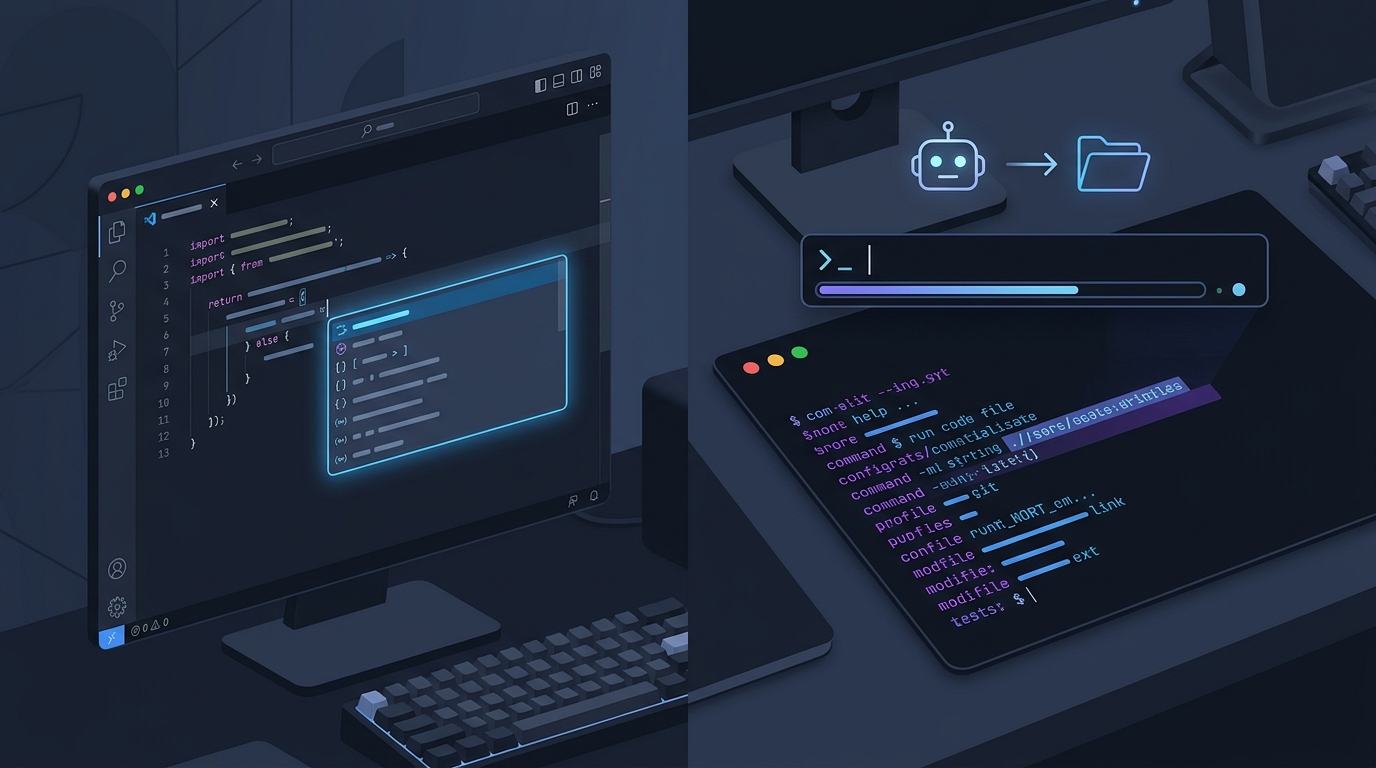
Anthropic’s Claude Code takes a different philosophy. Rather than operating in a separate sandbox, Claude Code works directly in the developer’s environment—reading files, running commands, and making changes through the terminal. This integration trades some autonomy for transparency and control.
Claude Code excels at:
- Large codebase navigation: Understanding and modifying complex existing projects
- Iterative development: Working alongside developers in real-time
- Context awareness: Maintaining understanding across long development sessions
- Safety boundaries: Operating within defined permissions and constraints
The integration model means developers see exactly what Claude Code is doing, can interrupt and redirect at any point, and maintain their existing workflows. It’s less “hire an AI engineer” and more “pair program with an AI expert.”
Key Differentiators
Autonomy vs. Control
The fundamental tension in autonomous coding is between capability and control. Fully autonomous agents can accomplish more without interruption but may go down unproductive paths. Integrated agents keep humans in the loop but require more interaction.
Devin and OpenHands lean toward autonomy—give them a task and return later for results. Claude Code leans toward collaboration—work together in real-time with human oversight. Both approaches have merits depending on the use case.
Benchmark Performance
The SWE-bench benchmark, which tests agents on real GitHub issues, has become a standard measure. As of late 2024, top performers resolve 40-50% of benchmark issues autonomously. This represents massive improvement from early 2024, when 15% was considered impressive.
However, benchmarks don’t capture everything. Real-world effectiveness depends on:
- Handling ambiguous requirements
- Understanding project-specific conventions
- Integrating with existing CI/CD pipelines
- Managing long-running tasks without losing context
Enterprise Considerations
For organizations evaluating these tools, several factors matter beyond raw capability:
- Data privacy: Where does code go? Is it used for training?
- Security: What can agents access? How are permissions managed?
- Auditability: Can you trace what changes the agent made and why?
- Integration: Does it work with your IDE, repo hosts, and workflows?
Claude Code and self-hosted OpenHands offer advantages here, while cloud-based solutions trade some control for convenience.
The Technical Evolution
Planning and Reasoning
Early coding agents often failed on multi-step tasks, losing track of goals or making inconsistent changes. Recent improvements focus on explicit planning—agents that outline their approach before diving into code, then validate each step against the plan.
Techniques like tree-of-thought prompting and hierarchical task decomposition have significantly improved success rates on complex tasks. Agents increasingly “think before they code.”
Tool Use Sophistication
Modern coding agents don’t just write code—they use a growing toolkit:
- Code search: Semantic search across large codebases
- Web browsing: Documentation lookup and API exploration
- Static analysis: Linting and type checking integration
- Testing: Running and interpreting test suites
- Debugging: Reading stack traces, setting breakpoints, inspecting state
The sophistication of tool use is a key differentiator. Agents that can effectively read error messages, search documentation, and iteratively debug significantly outperform those limited to code generation.
Memory and Context
Maintaining context across long development sessions remains challenging. Solutions include:
- Conversation summaries: Compressing earlier context
- Codebase indexing: Maintaining searchable representations of the project
- Task persistence: Saving and resuming interrupted work
- Learning from feedback: Improving based on corrections
Claude Code’s ability to maintain context across extended sessions addresses a real pain point in development work.
What’s Coming Next
Agentic IDEs
The next evolution may be IDEs built around agentic workflows. Rather than AI as an add-on, the development environment itself becomes agent-aware—with persistent context, natural language task queues, and AI-native version control.
Multi-Agent Development Teams
Just as human teams include specialists, future development may involve multiple specialized agents—a planning agent, a coding agent, a testing agent, a code review agent—coordinating on complex projects. Early experiments with frameworks like AutoGen and CrewAI point toward this future.
Domain Specialization
General-purpose coding agents may give way to specialists: agents trained specifically for web development, data engineering, mobile apps, or infrastructure. Domain expertise could dramatically improve both capability and reliability.
Continuous Learning
Current agents are static—they don’t improve from one session to the next. Future agents may learn from their mistakes, building project-specific knowledge and getting better over time. This raises interesting questions about intellectual property and knowledge accumulation.
Implications for Developers
The question isn’t whether autonomous coding agents will impact software development—they already have. The question is how the relationship between developers and agents will evolve.
Some predictions seem likely:
- Junior tasks will be increasingly delegated: Boilerplate, routine bug fixes, and simple features are prime candidates for agent handling
- Senior developers become orchestrators: The skill shifts from writing code to directing agents, reviewing output, and handling edge cases
- Debugging becomes reviewing: Less time writing code, more time ensuring AI-generated code is correct and secure
- Architecture matters more: High-level design decisions become the key human contribution
The developers who thrive will be those who learn to effectively collaborate with AI agents—knowing when to delegate, how to provide context, and how to verify results.
Conclusion
Autonomous coding agents have progressed remarkably in 2024. From Devin’s groundbreaking demos to OpenHands’ open-source innovation to Claude Code’s integrated workflow, we’re seeing different visions of AI-augmented development.
The technology isn’t perfect—agents still struggle with novel problems, complex architecture decisions, and edge cases that require deep domain knowledge. But the trajectory is clear. Each month brings improvements in benchmarks, new capabilities, and broader adoption.
For software teams today, the practical advice is straightforward: experiment with these tools on low-risk tasks, develop intuitions about their strengths and limitations, and build workflows that leverage their capabilities while maintaining quality. The future of coding is collaborative, and the collaboration has already begun.
Looking for more insights on AI in software development? Subscribe to our newsletter for weekly updates on frameworks, tools, and best practices in the AI agents ecosystem.
Related Posts

OpenHands: The Leading Open Source AI Coding Agent
A deep dive into OpenHands (formerly OpenDevin), the open-source autonomous coding agent that can do anything a human developer can—from writing code to browsing the web

AI Coding Agents in 2026: The Real Adoption Story
84% of devs use AI coding tools. METR found experienced devs 19% slower. The adoption paradox, measured.
Cursor vs Claude Code: Which AI Coding Agent Wins in 2026?
IDE-native AI vs autonomous terminal agent. Head-to-head on autocomplete, multi-file ops, pricing, and SWE-bench scores. Clear verdict included.