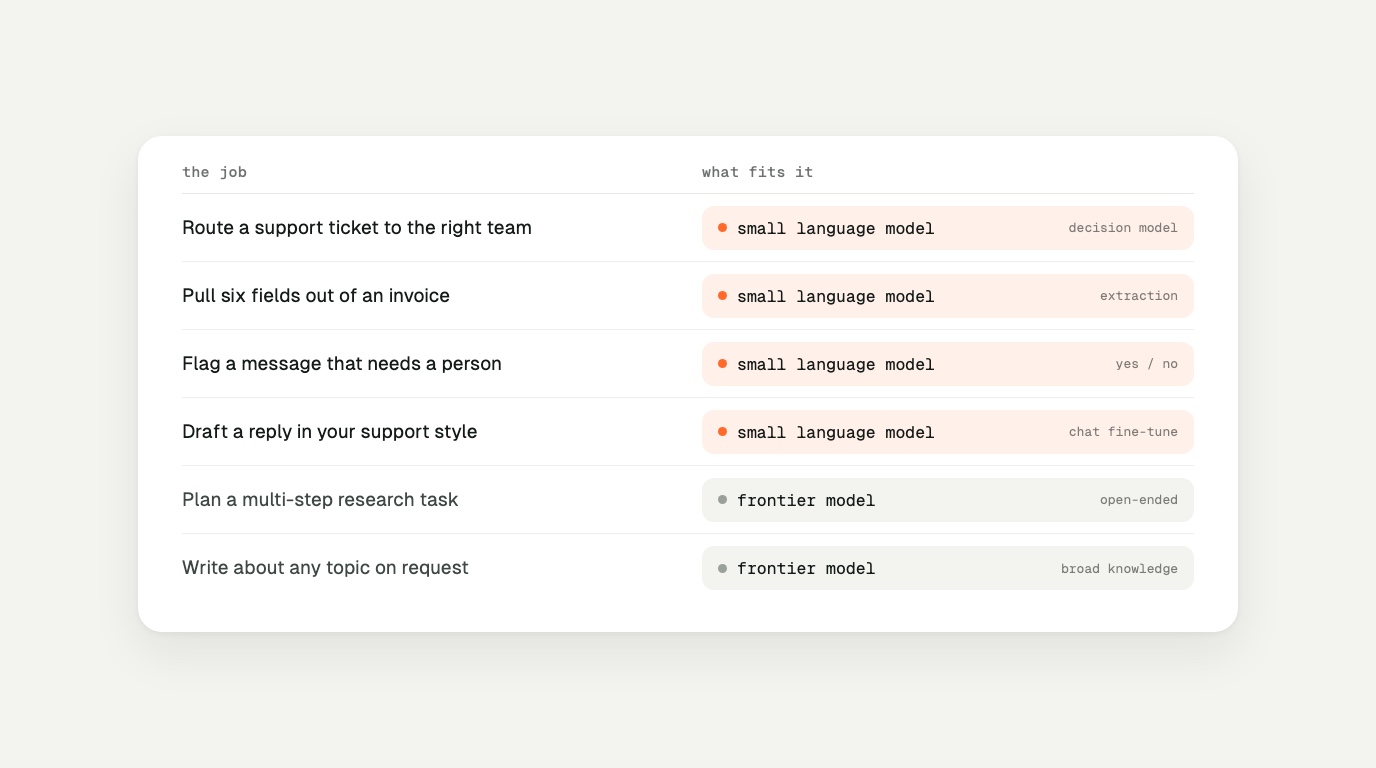
Most of what a business asks a language model to do is narrow and repeated: send a ticket to the right team, pull six fields out of an invoice, decide whether a message needs a person. A frontier model handles all of it, but it is built for every task at once, and you pay for that breadth on each call. A small language model trained on your own examples can often do the narrow job as well or better, answer faster, and run on a GPU you choose.
This guide covers what small language models are, the evidence for when they beat a frontier model, the cases where they don’t, and how to train one on your data.
What a small language model is
There is no formal cutoff. In practice the term covers open-weight models from under 1 billion to about 15 billion parameters, small enough to train and serve on a single GPU. On turion, Qwen3.5 0.8B needs 8 GB of GPU memory to serve and Ministral 3 14B needs 40 GB. Frontier models are far larger. Most are only available through their makers’ APIs, and the largest open ones, such as DeepSeek V4 Flash at 284 billion parameters, need a multi-GPU server.
Out of the box, a small language model is a capable generalist but clearly weaker than a frontier model on open-ended work. Its value comes from fine-tuning. Trained on a few hundred to a few thousand examples of one task, it learns that task’s labels, formats and edge cases. We call the result a task-specific language model (TLM): a model that does one job your business repeats.
When a small language model beats a frontier model
The clearest evidence comes from narrow tasks. In LoRA Land (April 2024), Predibase fine-tuned 310 models, 10 base models on each of 31 tasks, with 4-bit LoRA. On average the fine-tunes beat their base models by 34 points and GPT-4 by 10 points. Frontier models have improved since, so the margin will be different today, but the reason for it has not changed. The frontier model knows more about the world; the fine-tune has seen far more examples of your task.
A June 2025 paper by NVIDIA researchers, Small Language Models are the Future of Agentic AI, makes the same case for agents. Most calls an agent makes are narrow, repeated steps, and the authors argue that small language models are “sufficiently powerful, inherently more suitable, and necessarily more economical” for many of them, with a larger model kept for the steps that need general conversation.
Smaller models also answer faster. Turion Extract, our 12-billion-parameter extraction model, answers in a median of 67 ms per request on one NVIDIA RTX PRO 6000.
When it’s a good fit
| A small language model fits when | Stay on a frontier model when |
|---|---|
| The answer has a fixed shape: a label from a list, fields from a document, a yes or no, a score, or short text in a set format | The work is open-ended: planning, research, or writing across many topics |
| The task repeats at volume, thousands of calls a day or more | Volume is low, so a per-call API price costs less than GPU time |
| You have examples of good answers, or a frontier model’s answers you trust | You have no examples yet and no way to tell a good answer from a bad one |
| Latency, cost per call, or where your data goes matters | The task needs broad, current knowledge that examples can’t cover |
Many systems use both. The small language model takes the common cases and the frontier model takes the rest. On turion, an agent’s route sends a share of its calls to the fine-tune and retries a call on the frontier model when the fine-tune returns an error.
What it costs per task
A frontier API bills each call by its tokens, so the bill grows in step with volume. A model you serve yourself bills for GPU time, so each call gets cheaper as the GPU gets busier.
As a worked example, take Turion Extract’s 67 ms median. One GPU answering one request at a time handles about 53,000 requests an hour. On turion a GPU-hour costs $1.80, which comes to about $0.03 per thousand requests while the GPU is busy. A chat model that writes out its answer takes longer per request, and a GPU serves several requests at once, so measure your own model. Idle time is billed too: a replica that stays warm between bursts costs the same per hour, and one that scales to zero takes a few minutes to start again.
For the API side, a thousand calls of a thousand input tokens is a million input tokens, billed at the model’s price per million plus its output. At low volume the API is usually cheaper. Where the line falls depends on your volume, the length of your prompts and the API model you would otherwise call.
Pick a base model
These are the bases on turion between 0.8 and 14 billion parameters, with the GPU memory each needs to train with LoRA and to serve.
| Base | Parameters | Methods | Train (LoRA) | Serve | Good for |
|---|---|---|---|---|---|
qwen3.5-0.8b | 0.8B | lora, full, decision | 4 GB | 8 GB | classification, extraction, local development |
qwen3.5-2b | 2B | lora, full, decision | 8 GB | 12 GB | classification, extraction, on-device |
gemma-4-e2b | 2.3B effective | lora, qlora, full, decision | 10 GB | 16 GB | on-device, classification, extraction |
ministral-3-3b | 3.8B | lora, qlora, full, decision | 12 GB | 12 GB | classification, extraction, cheap serving |
qwen3.5-4b | 4B | lora, full, decision | 14 GB | 12 GB | lightweight agents, tool calling, extraction |
gemma-4-e4b | 4.5B effective | lora, qlora, full, decision | 18 GB | 24 GB | on-device, extraction, routing |
ministral-3-8b | ~8.8B | lora, qlora, full, decision | 24 GB | 24 GB | support bots, tool calling |
qwen3.5-9b | 9B | lora, decision | 24 GB | 24 GB | general assistant, tool calling, support |
gemma-4-12b | 12B | lora, qlora | 32 GB | 32 GB | support bots, extraction |
ministral-3-14b | 13.9B | lora, qlora | 40 GB | 40 GB | general assistant, tool calling |
All ten are Apache-2.0. Start with the smallest base that passes your eval cases. When you’re unsure, train two sizes: if the larger one is much better, size is the limit, and if they are close, better data will help more. turion bases prints the current catalog, which also has larger bases up to 35 billion parameters and Turion Jev 31B, our own model for decisions and routing.
Train one on your own examples
1. Collect examples
Write each example as one line of JSONL. For a chat model that is a conversation in the OpenAI messages format, with the answer you want as the last assistant turn:
{"messages": [{"role": "user", "content": "How do I rotate an API key?"}, {"role": "assistant", "content": "Create the new key first, deploy it, then revoke the old one."}]}
Prompt and completion pairs, and CSV files with prompt and completion columns, work too. A few hundred varied examples is a reasonable start. More examples help more than more epochs, and the CLI warns when a job would get fewer than about 30 optimizer steps. Put 50 to 200 examples you hold back in a second file; they become the eval cases the job scores.
If you have no labelled examples but a frontier model already does the job well, its answers are your training data. Send its calls through the turion gateway, which keeps each one as a trace, and turion agent distil turns an agent’s traces into a dataset and fine-tunes a base on it. Evaluate, distil & route covers it step by step.
2. Train
pip install turion
turion login
turion train --base qwen3.5-2b --data support.jsonl \
  --evals support-evals.jsonl --name support-v1
The job runs on one GPU with LoRA and ends with the pass rate of the base model and of the fine-tune on your eval cases. Training is billed per GPU-second at $1.80 per GPU-hour, and the first 2 GPU-hours each month are free.
3. Compare and deploy
turion deploy acme/support-v1
turion providers set openai
turion eval acme/support-v1 --evals support-evals.jsonl --against openai/gpt-6-luna
acme stands for your handle. turion eval sends each eval case to both models and prints both pass rates, so you can see whether the fine-tune is ready to take over. The deployed model answers on an OpenAI-compatible endpoint, so switching is a change of base URL and model name in the client you already use.
When the answer is a label, train a decision model
If the task is to pick one option from a list, such as a ticket’s team, an intent, or whether an invoice is a duplicate, train a decision model instead of a chat model. It reads the input once and returns a probability for every option, so there is no text to parse, no answer outside your list, and a threshold you can set. turion train picks the decision method when your data is in the decision format, and the bases up to 9 billion parameters support it. How decision models work explains them in full.
Where to go next
- Training: bases, methods, hyperparameters and the eval report.
- Datasets: the formats and eval sets.
- LoRA, QLoRA, and PEFT: how the fine-tuning methods work.