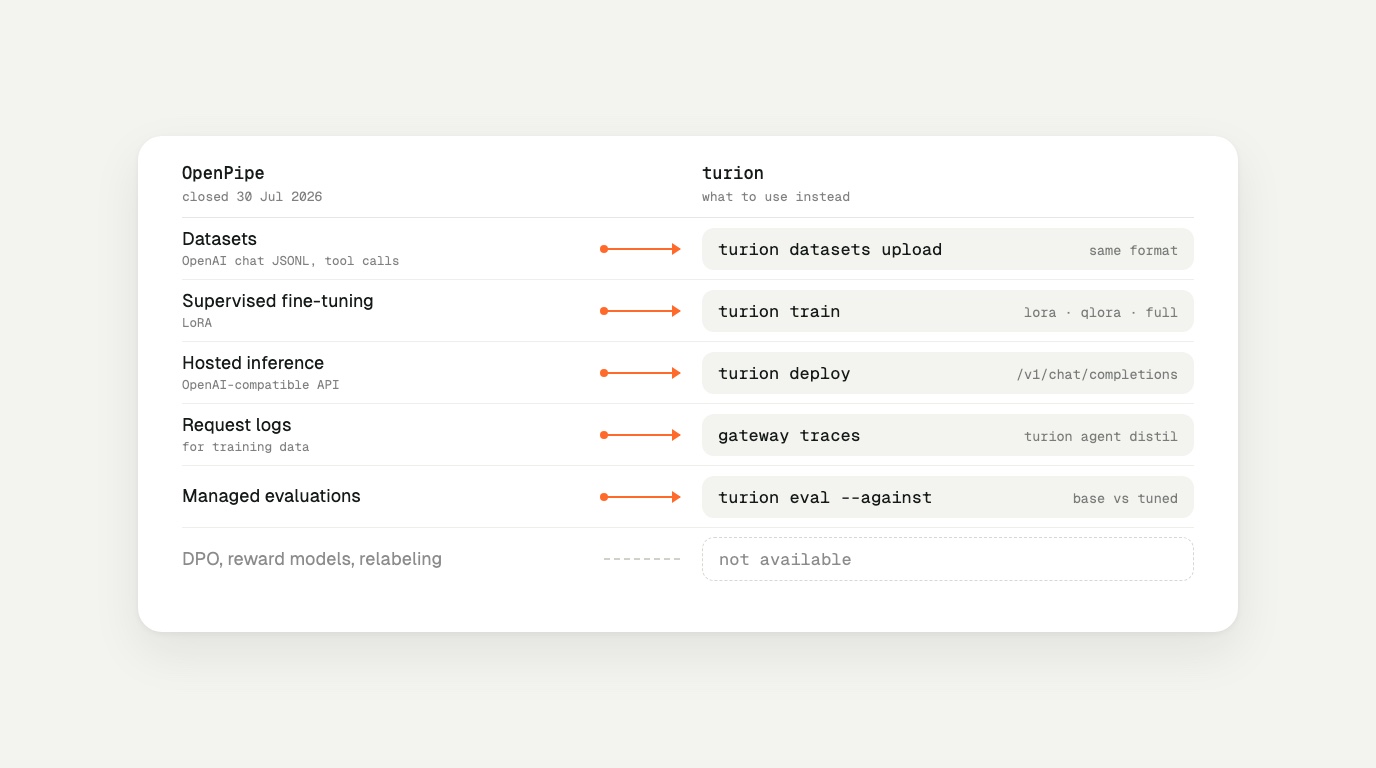
OpenPipe’s hosted platform stopped training and serving models on 30 July 2026, and its customers were offered a move to Weights & Biases, which CoreWeave owns. A year earlier Rubrik bought Predibase, the other company built for teams that fine-tune open models on their own data, and predibase.com now redirects to Rubrik’s agent product.
If you trained models on either platform, this post covers what happened, what the official migration gives you, and how to retrain the same models on turion from the data you already have. turion trains task-specific language models on your data and serves them on dedicated GPUs. The post also lists what turion does not offer, so you can tell early whether it fits.
What happened to OpenPipe
OpenPipe joined CoreWeave on 3 September 2025. On 18 May 2026 its founders announced that the legacy platform would close: “Effective July 30, 2026, it will no longer be possible to train new models or perform inference on existing models on OpenPipe.ai.” A migration tool moved existing models to W&B Inference. As of this writing app.openpipe.ai no longer resolves, openpipe.ai holds the migration notice and an archive of OpenPipe’s technical posts, and the open-source ART trainer is still maintained.
Training and inference moved to W&B. Six features were removed with the platform: reward models, managed evaluations, criteria, pruning rules, data pipelines (relabeling workflows) and DPO.
What happened to Predibase
Rubrik announced on 25 June 2025 that it would acquire Predibase. predibase.com, its pricing page and its documentation now redirect to Rubrik Agent Cloud, and we could not find a self-serve fine-tuning product with public prices in their place.
If you used the migration tool
Your models now run on W&B Inference, and new ones are trained on W&B Training. Its supervised fine-tuning trains a LoRA adapter with a rank and alpha the platform sets for each base model, which you can’t change. It is in public preview, hosts every checkpoint automatically and adds reinforcement learning. If that fits your work, staying is the shortest path.
turion is worth a look if you want to choose the training method and its settings, score a fine-tune against the model you run today before you switch, or keep training and serving on dedicated GPUs in the EU, the US or another region.
What carries over
| On OpenPipe | On turion |
|---|---|
| Datasets in the OpenAI chat format, tool calls included | turion datasets upload takes the same JSONL with no conversion |
| Supervised fine-tuning with LoRA | turion train: LoRA by default, QLoRA, or a full fine-tune on bases up to about 9B parameters. You set the rank, epochs and learning rate |
| Inference behind an OpenAI-compatible API | turion deploy serves the model on POST /v1/chat/completions and scales it to zero when idle |
| Request logs as training data | The turion gateway keeps every call as a trace, and turion agent distil trains a model on an agent’s traces |
| Managed evaluations | Every training job scores the base model and the fine-tune on your eval cases, and turion eval --against compares any two models. The matchers are deterministic (exact, contains, regex, JSON, F1), with no LLM judge |
| DPO, reward models, relabeling | Not available on turion |
Move a model in four steps
1. Collect the data
If you exported your datasets from OpenPipe before 30 July, you have JSONL in the OpenAI chat format, which turion trains on as it is: one {"messages": [...]} record per line, with tools and tool_calls when the model calls functions. Unknown keys are dropped on upload. Put the rows you held out for testing in a second file; they become your eval cases.
If you didn’t keep a copy, the calls your application makes today are the next source. Send them through the turion gateway with your own OpenAI or Anthropic key and each call is kept as a trace. For an agent deployed on turion, turion agent distil turns those traces into a training set and fine-tunes a base on it; Evaluate, distil & route walks through it.
2. Train
pip install turion
turion login
turion train --base gemma-4-e4b --data support.jsonl \
  --evals support-evals.jsonl --name support-v2
The CLI validates both files on your machine, uploads them, and follows the job on one GPU until the model is ready. It ends with the base and tuned pass rates on your eval cases. turion bases lists the base models in the catalog, with the methods each supports and the GPU memory each needs. Any public Hugging Face model also works with --base hf:<org>/<repo>, but gated repos, such as Meta’s Llama models, are refused. If your OpenPipe model was built on one, pick an ungated base of a similar size and compare them on your eval cases.
3. Deploy
turion deploy acme/support-v2
The model answers on the OpenAI-compatible endpoint as acme/support-v2. With no traffic its GPUs shut down, and the next request starts them again in a few minutes; keep a replica warm with --min-replicas 1 if that first call can’t wait.
4. Compare it with what you run today, then switch
turion providers set openai
turion eval acme/support-v2 --evals support-evals.jsonl --against openai/gpt-6-luna
turion eval sends each case to both models through the gateway and prints both pass rates. When the fine-tune holds up, change the base URL and the model name in your client:
import os
from openai import OpenAI

client = OpenAI(
    base_url="https://api.turion.ai/v1",
    api_key=os.environ["TURION_API_TOKEN"],
)
reply = client.chat.completions.create(
    model="acme/support-v2",
    messages=[{"role": "user", "content": "How do I rotate an API key?"}],
)
If you used the OpenPipe SDK, a drop-in replacement for the OpenAI SDK that recorded each call for training, go back to the OpenAI SDK and make the same two changes. Requests and responses keep OpenAI’s shapes, so the code around them stays as it is.
What it costs
Training is billed per GPU-second at $1.80 per GPU-hour, for the time the trainer spends loading and training; a job that uses 412 GPU-seconds costs about $0.21. The first 2 GPU-hours each month are free. A deployed model is billed at the same rate while a replica is up, keep-alive included, plus the loading time of a cold start. A training job never shares a GPU with another customer’s, and each deployed model has its own GPUs, in the EU, the US or another region.
Your weights stay private in your account and are never used for anyone else. There is no download button yet; email hello@turion.ai for an export of your adapter or weights.
If you were on Predibase
Predibase served many LoRA adapters from one GPU with its open-source LoRAX server, and it offered reinforcement fine-tuning. turion serves each deployed fine-tune on its own replicas, so keeping many adapters warm costs more than it did on LoRAX; one that nobody calls scales to zero. turion has no reinforcement learning. Supervised fine-tunes move the same way as OpenPipe’s: the JSONL, turion train, turion deploy.
When a decision model fits better
If the model you trained on OpenPipe picks a label, such as a ticket’s team, an intent or a yes or no, a decision model may suit the job better than a chat fine-tune. It answers with a probability for every option, so there is no text to parse and no answer outside your list. How decision models work explains them, and turion train picks the decision method when your data is in the decision format.
Where to go next
- Datasets: the formats, validation and eval sets.
- Training: bases, methods, hyperparameters and the eval report.
- Deploy & call: replicas, keep-alive, cold starts and the OpenAI SDKs.
- Evals: writing cases and comparing two models.