Build vs Buy AI Agents: The Enterprise Decision Framework for 2026

Gartner says AI spending hits $2.52T this year, but 88% of agents never reach production. The build-vs-buy question is where most of that money gets burned. Here's a concrete framework for making the call — with real cost data and zero vendor spin.
Your VP of engineering wants to build. Your CTO just came back from a vendor lunch and wants to buy. Your CFO wants to know why the spreadsheet has two wildly different numbers on the same line.
Welcome to the build-vs-buy conversation for AI agents in 2026. It’s the single most expensive decision most engineering organizations will make this year — and most teams are approaching it with gut instinct, not data.
Here’s what we actually know: Gartner forecasts worldwide AI spending at $2.52 trillion in 2026, up 44% year-over-year. But a March 2026 survey of 650 enterprises found that 78% have AI agent pilots and fewer than 15% reach production. MIT’s NANDA research is even sharper: 95% of generative AI pilots fail to reach production.
The build-vs-buy decision is where that delta lives. Get it right, and you’re in the 5-15% that ship. Get it wrong, and you join the $2.5T write-off club.
The Real Cost of Building
Let’s put numbers on the table. These aren’t vendor quotes — they’re drawn from surveys of 40+ actual builds:
| Build tier | Initial build cost | Monthly run cost | Year 1 total |
|---|---|---|---|
| Simple single-agent (chatbot, RAG) | $5K – $25K | $500 – $1,500 | $11K – $43K |
| Mid-complexity (multi-tool, eval pipeline) | $25K – $100K | $1,500 – $5,000 | $43K – $160K |
| Enterprise multi-agent system | $100K – $500K+ | $2,000 – $10,000+ | $124K – $620K+ |
Sources: Patrick Hughes survey of 40+ builds, ServicesGround 2026 breakdown.
Now add the hidden costs that don’t appear in any spreadsheet:
Infrastructure engineering. Running agents in production isn’t model inference. It’s state management, retry logic, guardrails, observability, sandboxing, and multi-tenancy. Our own analysis of enterprise AI agent TCO found that infrastructure engineering typically consumes 40-60% of the total build effort — and that’s before you hit the agent durability gap.
Eval infrastructure. A production agent without evals is a liability. But building eval pipelines from scratch — test case generation, regression suites, scoring rubrics — is a product in itself. Every builder we talk to underestimates eval by at least 3x.
Ongoing maintenance. The Knowlee framework estimates 30-40% annual maintenance cost on top of initial build. Model deprecations, prompt drift, tool API changes, and framework churn don’t stop when you ship.
The talent tax. AI engineers who can build production agent systems command $200K-$350K+ in 2026. You need at least 2-3 to staff a meaningful build effort. That’s a recurring $600K-$1M annual line item before you write a single line of agent code.
When Building Actually Makes Sense
Building isn’t always wrong. It wins in three specific scenarios:
1. The agent is core IP. If the agent’s reasoning logic, domain model, or decision patterns are what differentiate your business, outsourcing that to a platform is strategic surrender. A hedge fund’s trading agent, a drug discovery pipeline, a proprietary underwriting model — build.
2. You have sovereign control requirements. Regulated industries (defense, certain finance verticals, government) that can’t route data through third-party platforms have no choice. But verify this constraint is real — many “compliance requirements” turn out to be internal preferences, not regulatory mandates.
3. The platform doesn’t exist yet. For truly novel agent architectures — multi-agent collaboration with custom communication patterns, agents operating on proprietary data formats, agent-to-agent negotiation protocols — the platform market hasn’t caught up. You build because there’s nothing to buy.
Even in these cases, the Kellton hybrid framework recommends a carve-out approach: buy the commodity layer (hosting, observability, basic guardrails), build only the differentiated core. Gartner projects more than 40% of enterprises will adopt this hybrid model by end of 2026.
The Buy Side: What Platforms Actually Cost
The buy path isn’t cheap, but the cost is predictable — and that matters more than the absolute number to most CFOs.
Salesforce Agentforce charges $0.10 per agent action via Flex Credits. ServiceNow’s AI agents are bundled into its AI-native licensing model, with the new AI Control Tower (June 2026 release) extending governance across both ServiceNow and Microsoft platforms. Microsoft Copilot Studio has 160,000 organizations running 400,000+ custom agents.
For a mid-complexity use case (say, an internal IT support agent handling 5,000 tickets/month), the platform path typically runs $15K-$50K/year in licensing — a fraction of the equivalent build cost. But you’re trading dollars for control: platforms constrain your model choices, your deployment topology, and your customization surface.
A Decision Framework That Actually Works
Forget the two-column pro/con list. Here’s the framework we use with teams making this decision today:
Step 1: Classify the use case
| Dimension | Build signal | Buy signal |
|---|---|---|
| Strategic differentiation | Core business logic | Operational efficiency |
| Data sensitivity | Sovereign/regulated | Standard enterprise |
| Workflow complexity | Novel, multi-agent, custom communication | Standard automation patterns |
| Team capability | 2+ senior AI engineers on staff | Generalist engineering team |
| Timeline | 6-12 months acceptable | Need results in <3 months |
| Evals complexity | Custom domain-specific metrics needed | Standard accuracy/safety evals sufficient |
Step 2: Run the Year-1 TCO model
Don’t compare build cost to license cost. Compare total cost of ownership across three buckets:
- People: engineer salaries × headcount × % allocation
- Infrastructure: compute, model APIs, hosting, observability tools
- Risk: cost of delay, cost of failure, cost of rebuild if you switch paths
We’ve covered the full TCO model in our enterprise AI agent ROI analysis. The short version: most teams underestimate Year-1 build TCO by 2-3x because they omit maintenance, evals, and the risk bucket entirely.
Step 3: Answer the one question that matters
If we build this, will the thing we’re building be a differentiator in 18 months — or a maintenance burden?
If it’s the former, build. If it’s the latter, buy. If you’re not sure, start with a platform, prove the value, and only build the pieces that genuinely differentiate.
47% of enterprises already run this hybrid model, according to Kellton’s 2026 framework. The number is growing because it works: you get platform speed for the commodity layer and custom engineering where it actually matters.
What Changes by December 2026
Three dynamics are shifting faster than most teams realize:
Platform governance is becoming the moat. ServiceNow’s AI Control Tower expanding across platforms (including Microsoft), Salesforce’s Agentforce governance layer, and the emerging MCP/A2A protocol stack — these aren’t features, they’re the new table stakes. If you build, you’re also building your own governance plane. That’s a product, not a feature.
Model commoditization changes the build calculus. As we argued in our analysis of the great LLM commoditization, switching between GPT-5, Claude, and Gemini now costs weeks, not months. The build path gets cheaper on the model layer — but the infrastructure and ops layers don’t budge.
The talent market is bifurcating. Platform engineers who can configure and govern Agentforce/Copilot Studio are abundant and cost $130K-$180K. AI infrastructure engineers who can build production agent systems from scratch cost $200K-$350K and have 3+ competing offers. The build path’s talent tax is getting worse, not better.
The Bottom Line
Most organizations should buy the commodity layer and build only the differentiation layer. The hybrid model isn’t a compromise — it’s the only architecture that matches economic reality in 2026.
If your team is debating this right now: model the Year-1 TCO with the risk bucket included, classify each use case against the six dimensions above, and ask the differentiation question honestly. The worst outcome isn’t building when you should have bought. It’s building something that becomes a maintenance burden, never ships, and consumes engineering talent that could have been building what actually matters.
The 88% of agents that never reach production? Most of them were built, not bought.
Related Posts

The Agent Pricing Crisis: Nobody Knows How to Bill for Intelligence
Anthropic paused its Agent SDK billing overhaul on launch day. Salesforce ditched $2/conversation for Flex Credits. Per-seat SaaS is dying, and agent-native pricing remains an unsolved equation. Here's why — and what comes next.

AI's Infrastructure Gap: Why 88% of Pilots Fail
79% of companies are adopting AI agents. Only 2% run them at scale. The bottleneck isn't models — it's the infrastructure underneath.
The AI Agent Adoption Gap Nobody Wants to Talk About
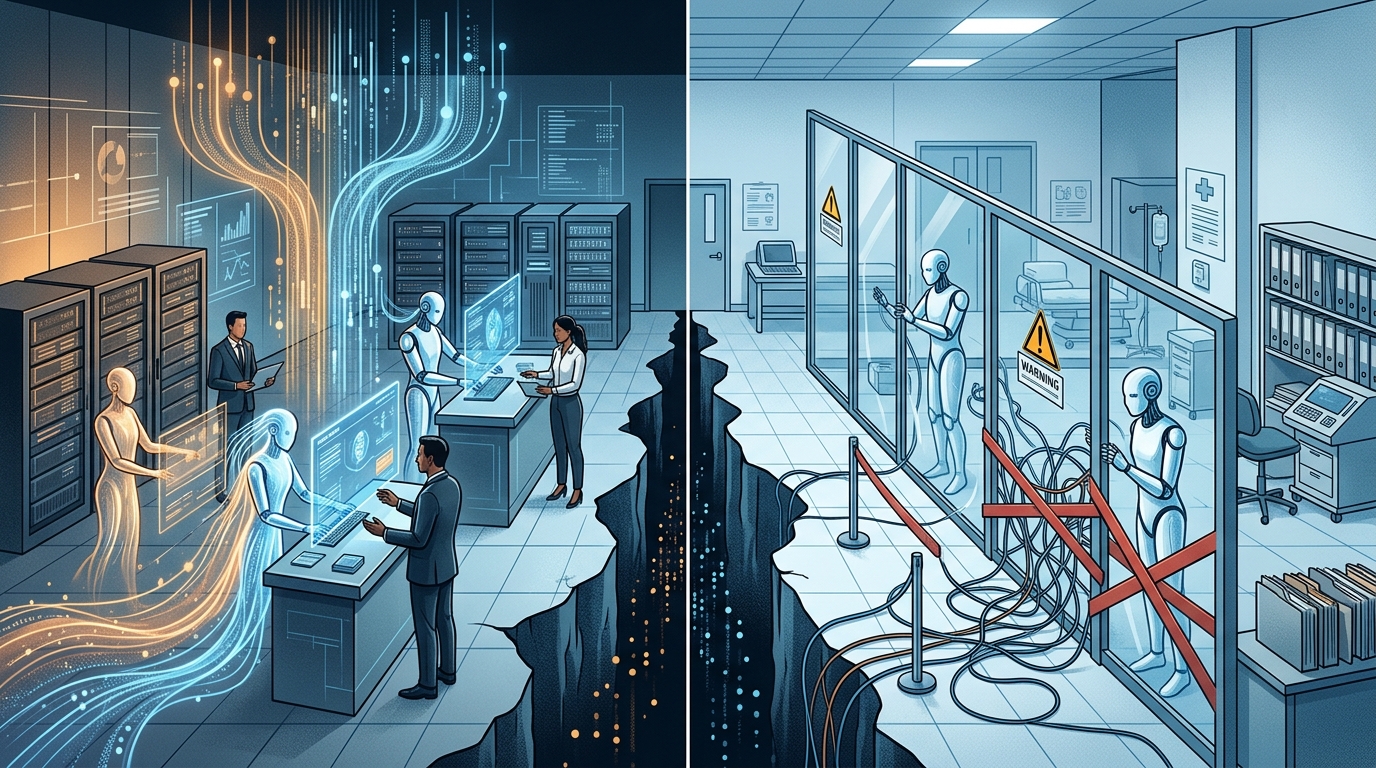
Banking runs AI agents in production at 47%. Healthcare? 18%. The gap isn't about technology — it's regulatory friction, incentive misalignment, and the quiet truth that some industries aren't ready.