Complete Guide to AI Agent Frameworks 2026
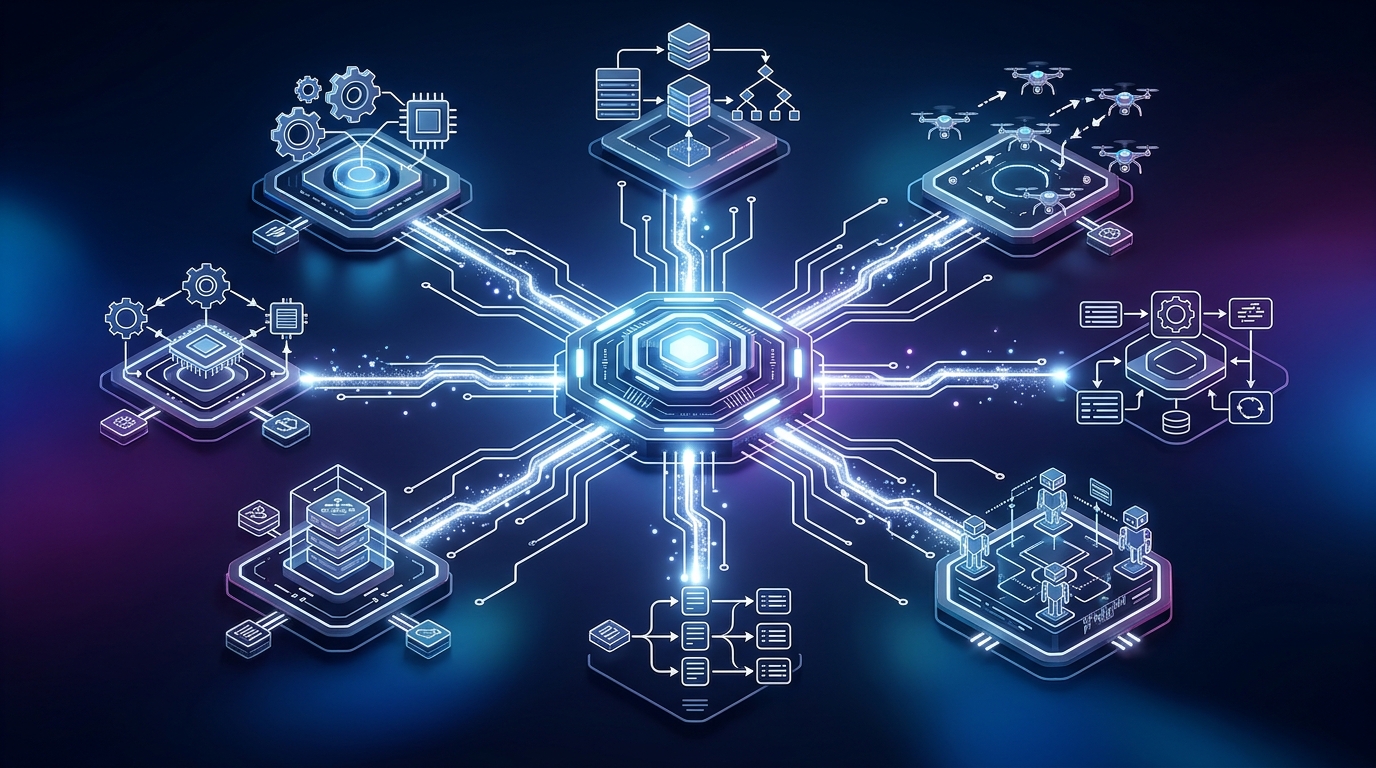
OpenAI Agents SDK, Claude Agent SDK, LangGraph, CrewAI compared — with benchmarks and a decision framework for your AI stack.
The AI agent framework landscape has consolidated around a handful of serious contenders. In 2024, every week brought a new orchestrator. In 2026, the market has sorted itself by workload type, not by hype.
We’ve built production systems across LangGraph, the OpenAI Agents SDK, the Claude Agent SDK, CrewAI, and AutoGen at Turion. Each framework makes different trade-offs between control, abstraction, and operational overhead. This post maps those trade-offs with concrete code and benchmarks so you can pick the right tool without spending three months on a proof-of-concept.
The Four Categories of Agent Frameworks in 2026
Stop thinking of frameworks as interchangeable. They cluster into four distinct categories:
| Category | Examples | Strength | Trade-off |
|---|---|---|---|
| Agent-loop harnesses | OpenAI Agents SDK, Claude Agent SDK | Model-native loops, structured output, sandboxing | Vendor-locked to one model family |
| Graph-based orchestrators | LangGraph | Explicit state machines, deterministic control flow | Higher code complexity, more boilerplate |
| Multi-agent frameworks | CrewAI, AutoGen | Role-based teams, easy multi-agent composition | Black-box orchestration, harder to debug |
| Glue libraries | LangChain, LlamaIndex | Tool abstractions, RAG pipelines, integrations | Heavy abstraction layers, steep learning curve |
For terminology used throughout this post, see our AI Agents Glossary. For the latest May 2026 framework news, see our platform updates roundup.
The key insight: most production systems use one framework from two categories. A graph orchestrator plus a glue library for tool definitions is the most common pattern we see.
1. OpenAI Agents SDK — The Managed Harness
The OpenAI Agents SDK treats agents as imperative handoff chains. Its April 2026 update introduced native sandbox execution, a more capable agent harness for long-horizon tasks, and model-native structured output enforcement (TechCrunch, April 2026).
from openai import OpenAI
from openai.agents import Agent, Runner, function_tool

@function_tool
def search_database(query: str) -> str:
    """Search the product database for matching items."""
    # Real implementation here
    results = execute_search(query)
    return format_results(results)

research_agent = Agent(
    name="ResearchAgent",
    instructions="You research products in our database.",
    tools=[search_database],
    model="gpt-4.1",
)

async def main():
    result = await Runner.run(
        research_agent,
        "Find all wireless headphones under $200",
    )
    print(result.final_output)
What makes the Agents SDK stand out in 2026:
- Structured outputs by default — every response validates against a JSON schema, not a free-form string. We use
output_typewith Pydantic models on every production agent. No exceptions. - Native sandbox execution — code execution runs in isolated environments, solving the sandbox gap that previously required spinning up E2B or Modal separately.
- Handoff-based multi-agent — agents delegate via explicit
handoff()calls, creating a controlled call graph rather than the free-for-all message passing of earlier multi-agent frameworks. - Model routing — the same agent can switch between GPT-4.1 for reasoning and GPT-4.1-mini for classification tasks, optimizing cost per step.
Best for: production systems already committed to OpenAI’s model family that need predictable agent loops without the overhead of graph orchestration.
2. Claude Agent SDK — The Autonomous Agent Engine
Anthropic’s Claude Agent SDK targets fully autonomous agents that can plan, act, and self-correct. It ships with built-in code execution, file system access, and subagent spawning.
from anthropic import Anthropic

client = Anthropic()

response = client.messages.create(
    model="claude-sonnet-4-20260124",
    max_tokens=8096,
    system="You are a research assistant. "
           "Use available tools to answer questions accurately. "
           "Always verify information before presenting it.",
    tools=[
        {
            "name": "search_web",
            "description": "Search the web for current information",
            "input_schema": {
                "type": "object",
                "properties": {
                    "query": {"type": "string", "description": "Search query"}
                },
                "required": ["query"]
            }
        }
    ],
    messages=[{"role": "user", "content": "What are the latest AI agent framework releases?"}]
)
Key properties:
- Extended thinking with interleaved execution — Claude can think, act on tools, think again, and refine, all within a single API call (Anthropic docs).
- Subagent architecture — spawn focused subagents that inherit partial context, enabling parallel work without manual state management.
- Prompt-driven, not graph-driven — agents follow natural language instructions rather than state machine definitions. This makes them faster to iterate but harder to audit.
Best for: coding agents, research agents, and any workload where the model needs to autonomously decompose open-ended tasks.
3. LangGraph — The Explicit State Machine
LangGraph models agents as state machines over a shared graph. Every transition is explicit, every node is a function you wrote, and every edge is a conditional you control. For a beginner-friendly walkthrough, see our LangGraph Tutorial. For human-in-the-loop patterns, see our LangGraph HITL Guide.
from typing import TypedDict, Literal
from langgraph.graph import StateGraph, END

class AgentState(TypedDict):
    messages: list
    current_step: str
    result: str

def research_node(state: AgentState) -> AgentState:
    query = state["messages"][-1]["content"]
    findings = search_database(query)
    return {
        "messages": state["messages"] + [{"role": "assistant", "content": findings}],
        "current_step": "analyzed",
        "result": findings
    }

def verify_node(state: AgentState) -> AgentState:
    is_valid = validate_result(state["result"])
    return {
        "messages": state["messages"] + [
            {"role": "assistant", "content": f"Validation: {'PASS' if is_valid else 'FAIL'}"}
        ],
        "current_step": "verified" if is_valid else "retry"
    }

def should_continue(state: AgentState) -> Literal["verify", END]:
    if state["current_step"] == "analyzed":
        return "verify"
    return END

builder = StateGraph(AgentState)
builder.add_node("research", research_node)
builder.add_node("verify", verify_node)
builder.set_entry_point("research")
builder.add_conditional_edges("research", should_continue)
builder.add_edge("verify", END)

graph = builder.compile()
What LangGraph gets right:
- Deterministic control flow — the graph is your documentation. Anyone reading the code sees exactly what happens at each step.
- Checkpoints and persistence — built-in checkpointing lets you pause, resume, and replay agent runs. This is essential for production debugging.
- Human-in-the-loop — interrupt at any node to get approval before continuing.
- Model-agnostic — swap between OpenAI, Anthropic, Google, and local models without changing graph logic.
The trade-off: every routing decision, error path, and retry loop requires explicit code. Your graph grows quickly. For teams building simple task-decomposition agents, LangGraph is often overkill.
Best for: enterprise workflows where auditability, deterministic behavior, and human checkpointing are non-negotiable.
4. CrewAI — Role-Based Multi-Agent Teams
CrewAI structures agents as role-based teams working toward a shared objective. Each agent has a role, goal, and backstory, and a “crew” coordinates their output.
from crewai import Agent, Task, Crew

researcher = Agent(
    role="Senior Product Analyst",
    goal="Identify market gaps in wireless headphones under $200",
    backstory="You are a product analyst with 10 years of experience "
              "in consumer electronics market research.",
    verbose=True
)

writer = Agent(
    role="Technical Content Writer",
    goal="Write a comprehensive product comparison article",
    backstory="You write clear, concise technical content "
              "for consumer electronics blogs.",
    verbose=True
)

task1 = Task(
    description="Research wireless headphones under $200 on the market",
    expected_output="List of 10 products with specs and pricing",
    agent=researcher
)

task2 = Task(
    description="Write a comparison article based on research findings",
    expected_output="800-word comparison article with pros and cons",
    agent=writer
)

crew = Crew(
    agents=[researcher, writer],
    tasks=[task1, task2],
    process="sequential"
)

result = crew.kickoff()
CrewAI’s strength is composability. You can swap agents, reorder tasks, and change the process from sequential to hierarchical without rewriting core logic. But the framework’s natural language role descriptions are more marketing flavor than technical substance — the underlying LLM doesn’t actually read the backstory.
For a deeper comparison of CrewAI and auto-generating frameworks, see our AutoGen vs CrewAI comparison.
Best for: content generation, research pipelines, and scenarios where role-based decomposition maps cleanly to the task.
5. AutoGen — Microsoft’s Conversational Agent Framework
AutoGen from Microsoft pioneered the multi-agent conversation pattern. Agents communicate through a group chat manager, and the framework supports code execution, human input, and tool calling within conversations.
from autogen import ConversableAgent, GroupChat, GroupChatManager

analyst = ConversableAgent(
    name="Analyst",
    system_message="You analyze data and produce summaries. "
                   "Use code execution when needed.",
    llm_config={"config_list": [{"model": "gpt-4.1", "api_key": "sk-..."}]},
    code_execution_config={"executor": "local"}
)

reviewer = ConversableAgent(
    name="Reviewer",
    system_message="You review summaries for accuracy and completeness. "
                   "Ask for corrections if needed.",
    llm_config={"config_list": [{"model": "gpt-4.1", "api_key": "sk-..."}]}
)

group_chat = GroupChat(
    agents=[analyst, reviewer],
    messages=[],
    max_round=10
)

manager = GroupChatManager(
    groupchat=group_chat,
    llm_config={"config_list": [{"model": "gpt-4.1", "api_key": "sk-..."}]}
)

result = analyst.initiate_chat(
    manager,
    message="Analyze Q1 revenue data and produce a summary."
)
AutoGen’s conversation pattern is powerful but opaque. When agents loop past max_round without converging, debugging requires reading the entire message history. The framework excels at research and coding tasks where iteration drives quality, but it struggles with latency-sensitive production workloads.
Best for: research experiments, coding assistants, and scenarios where multi-turn conversation between agents improves output quality.
6. LangChain & LlamaIndex — The Integration Layer
LangChain and LlamaIndex are not agent frameworks in the strict sense — they’re integration layers. LangChain provides chains, agents, and tool abstractions. LlamaIndex specializes in data ingestion, indexing, and retrieval.
If you’re building a RAG pipeline, you probably want LlamaIndex for the retrieval layer. If you need 200+ tool integrations out of the box, LangChain’s ecosystem is unmatched. But for agentic control flow, you’ll eventually layer LangGraph (from the LangChain team) or a dedicated orchestrator on top.
For a detailed comparison, see our LangChain vs LlamaIndex analysis and our three-way consolidation including Semantic Kernel.
Best for: RAG-heavy pipelines, tool integration breadth, and as a foundation layer beneath a dedicated agent orchestrator.
7. Google ADK — The Enterprise Contender
Google’s Agent Development Kit (ADK) provides a runtime for building and deploying agents on Google Cloud. It integrates with Vertex AI models, Google Workspace tools, and the Agent-to-Agent (A2A) protocol for cross-agent communication.
The A2A protocol itself, hosted by the Linux Foundation, has surpassed 150 organizations and gained integration across Google Cloud, AWS, and Azure (PRNewswire, April 2026).
Best for: Google-first enterprise stacks that need Agent-to-Agent interoperability and Vertex AI integration.
Decision Framework: Which Framework When?
We’ve deployed hundreds of agents across these frameworks. Here’s how we choose:
Use a harness (OpenAI / Claude Agent SDK) when:
- You need a single autonomous agent with tool access
- Model-native features (thinking, structured output, sandboxing) are essential
- You’re willing to accept model-family lock-in
Use a graph orchestrator (LangGraph) when:
- You need deterministic, auditable control flow
- Human-in-the-loop checkpoints are required
- Multi-model switching is a requirement
Use a multi-agent framework (CrewAI / AutoGen) when:
- The task naturally decomposes into roles or conversational phases
- Agent iteration (self-refinement, peer review) improves output
- Developer ergonomics matter more than step-level control
Use a glue library (LangChain / LlamaIndex) when:
- Your primary need is RAG, not agency
- You need 50+ pre-built tool integrations
- You’re building the data layer beneath another framework
What We’d Do Differently in 2026
If we started fresh today, we’d skip the debate entirely. The framework that matters is the one that matches your workload’s failure mode:
- If failures are silent (agent does the wrong thing confidently), you need LangGraph’s explicit state machines and LangSmith/Langfuse tracing. See our LangSmith vs Langfuse vs Arize Phoenix comparison for observability.
- If failures are noisy (agent loops, errors, retries), you need a harness’s built-in stopping conditions and sandbox isolation.
- If failures are structural (wrong tools, bad schemas), the framework doesn’t matter — you need better Agent-Computer Interface design. Anthropic’s engineering blog covers this extensively in their Writing Effective Tools for Agents post.
The frameworks will keep multiplying until the protocol layer stabilizes — MCP for tool access, A2A for agent coordination, and emerging standards for identity and payments. For a data-driven look at how enterprises are adopting these frameworks in production, see our State of AI Agents in Enterprise 2026 report and our GPU cloud pricing comparison to benchmark the infrastructure costs. For a realistic assessment of what ROI these investments deliver, see our enterprise AI agent ROI analysis. Until then, pick the framework that minimizes the distance between your agent’s failure mode and your ability to observe it. For the latest May 2026 framework updates, see our monthly platform updates post. For how the big three enterprise agent platforms compare, see our Salesforce vs ServiceNow vs Microsoft analysis.
Related Posts

The Complete Guide to AI Agent Frameworks in 2024
A comprehensive 3000+ word guide covering all major AI agent frameworks, their architectures, strengths, use cases, and how to choose the right one for your project
LangGraph vs CrewAI vs AutoGen: 2026 Comparison
Graph orchestration vs role-based teams vs Microsoft's new Agent Framework 1.0. Architecture, production readiness, and a clear verdict.

AutoGen vs CrewAI: Choosing the Right Framework
AutoGen vs CrewAI: head-to-head on architecture, ease of use, and use cases for multi-agent systems. Pick the right framework.