A decision model is a language model that answers typed questions about an input with a probability for every possible answer, and writes no text. You send a ticket and ask which team should handle it, and you get back each team with a probability. How decision models work explains the idea.
TypeSafe started the category with Jev in September 2026. Two months later more than a dozen companies host one. This post compares the ones you can call today, using each maker’s own pages as they stood on 26 November 2026. Turion Jev is ours, and what it does not do is in the same tables.
Prices on 26 November 2026
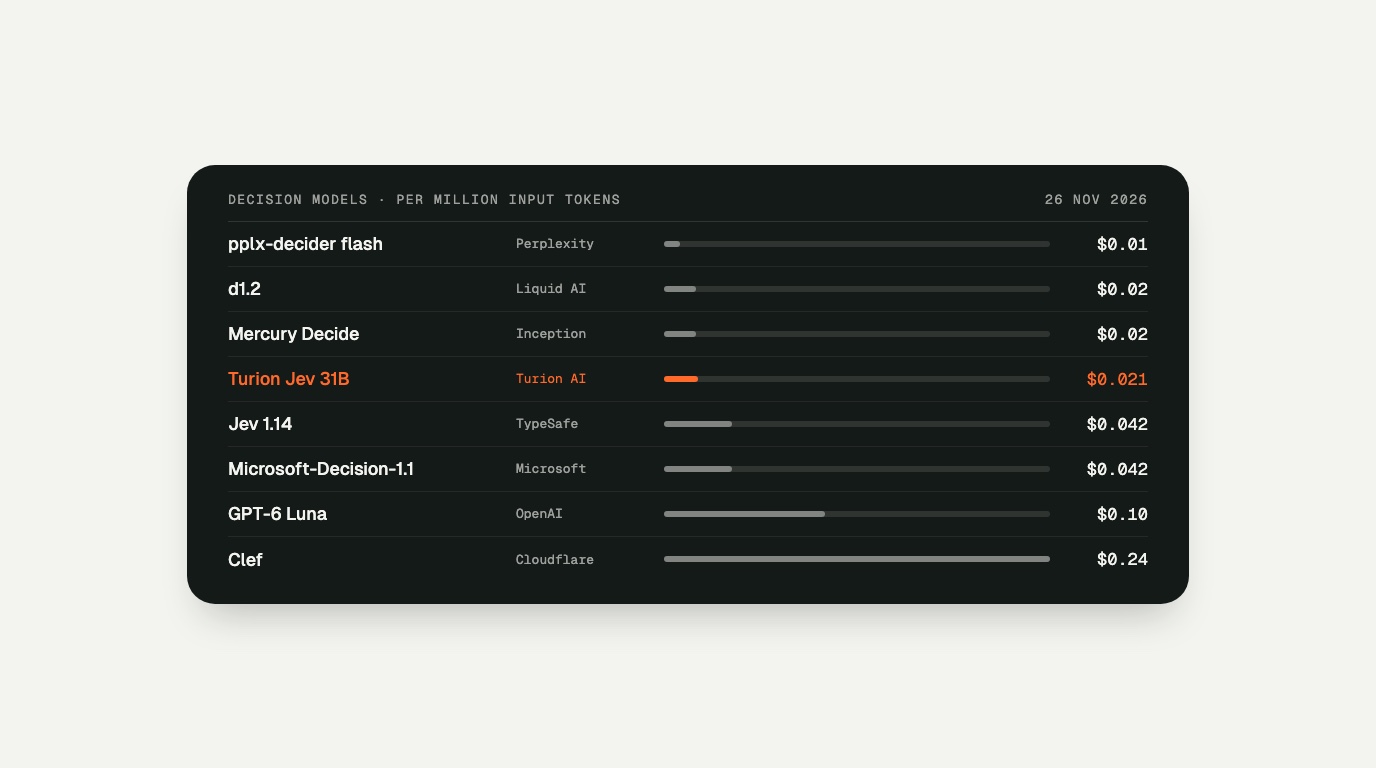
Decision models bill input tokens only, because they generate nothing. Prices are per million input tokens on the maker’s own API, and each model name links to the page the price comes from.
| Model | Maker | Per million input tokens | Weights |
|---|---|---|---|
| pplx-decider v1.3, and its flash model | Perplexity | $0.02, flash $0.01 | Open, Apache-2.0 |
| d1.2, d1.2-ultra | Liquid AI | $0.02, ultra $0.042 | Open for its smaller models, under Liquid’s own licence |
| Mercury Decide | Inception | $0.02, listed as half its regular $0.04 | Closed |
| Turion Jev 31B | turion | $0.021 | Open, Apache-2.0 |
| Jev 1.14 | TypeSafe | $0.042 | Closed |
| Microsoft-Decision-1.1 | Microsoft | $0.042 (Azure retail price list, Global Standard) | Closed |
| Clef, Clef-flash, Clef-omni | Cloudflare | $0.24, flash $0.038, omni $0.15 | Open, Apache-2.0 |
| GPT-6 Luna, through the Decisions API | OpenAI | $0.10 | Closed |
| Mammoth 1 | Base Labs, on Baseten | $0.10 | Open |
| Solar Decide, in beta | Upstage | $0.10 | Closed |
Parallel’s Decisions API is priced differently, at $1 per 1,000 requests, because each answer is grounded in a live web search and comes with citations. Perplexity offers web grounding on its decider as an extra, at $0.001 a search.
Several of these are also on OpenRouter, where the price is sometimes lower than the maker’s own. OpenRouter’s list of decision models has the current figures.
At these prices the cost of a decision is small either way. A 500-token ticket costs about a thousandth of a cent at $0.02 per million and about a hundredth of a cent at $0.24. The differences that matter more are below.
The API: TypeSafe’s schema or another
TypeSafe defined the first API, POST /v1/systemone, with a state and a map of questions of three types: choice, score and noul (yes or no). Code written against it moves between the providers that kept it.
- Same schema. Cloudflare calls Clef “fully Jev-API compatible”. Upstage says Solar Decide “uses the same /v1/systemone schema as Jev”. Liquid AI says TypeSafe’s SDKs work with d1 for text questions. Microsoft and Baseten each serve a path named
/v1/systemone, and Microsoft’s takes the same fields. turion serves/v1/systemoneas well, and TypeSafe’s official Python SDK calls Turion Jev once its base URL points athttps://api.turion.ai. - Their own schema. OpenAI’s Decisions API is
POST /v1/decisionswith aninputand a list of named questions, and calls a yes or no question a predicate. Perplexity, Parallel and Inception also use/v1/decisions, with field names close to TypeSafe’s.
If you may switch provider later, or want to test the same questions on two of them, the first group saves you a rewrite.
What they read, and how much
| Model | Context | Besides text and JSON |
|---|---|---|
| GPT-6 Luna | 1,050,000 tokens | Images |
| Solar Decide | 512,000 | Not stated |
| pplx-decider v1.3 | 256,000 | Images |
| Jev 1.14 | 64,000 per request; 262,000 with its long-context header | Images |
| Clef | 65,536 (flash 24,576) | Images and video; Clef-omni adds audio |
| d1.2 | 65,536 per question | Images and audio |
| Mammoth 1 | 16,000 | Images |
| Turion Jev 31B | 16,320 | Not available on turion: text and JSON only |
For routing tickets and checking records, 16,000 tokens is rarely the limit. For a long contract or a scanned page it is, and Turion Jev is the wrong choice there today.
The number of options a choice can have also varies. Jev, pplx-decider, Mercury Decide and Turion Jev take up to 255. Turion Jev takes up to 128 questions in one request, as Liquid’s d1 does, and OpenAI’s API takes up to 400.
Scores on the Decision Index
The Decision Index is the public board for these models. Its Full score comes from private tests, 60% on the same skills as its public benchmarks and 40% on tasks from domains the public set does not cover, so no entrant can train on what is scored. Models within 0.9 points of the first model in a group share a rank.
The board is mostly open models that people run themselves, and its top places belong to those. Of the hosted models in the price table, these are listed in the 21 November 2026 update of edition 0.4.1, which covers 346 models:
| Model | Full score | Rank group | Position by score |
|---|---|---|---|
| Turion Jev 31B | 70.47 | Tied #4 | 14 |
| Mammoth 1 | 68.44 | Tied #6 | 25 |
| pplx-decider v1.2 | 67.98 | Tied #6 | 30 |
| pplx-decider v1.3 | 67.67 | Tied #6 | 34 |
| Jev 1.14 | 60.24 | Tied #13 | 79 |
| pplx-decider flash v1.3 | 55.14 | Tied #17 | 120 |
| Clef | 54.92 | Tied #18 | 121 |
| Clef-omni | 45.04 | Tied #28 | 179 |
| Clef-flash | 44.43 | Tied #28 | 181 |
Microsoft-Decision-1.1, GPT-6 Luna, Mercury Decide, Solar Decide, Parallel and Liquid’s hosted d1.2 are not on the board, so there is no independent number to compare them by. Liquid’s small open models are listed, between 11 and 35 points.
The board also measures calibration: how far a model’s stated confidence is from how often it is right. Turion Jev 31B’s calibration error is 1.9 points, against 8.0 for Jev 1.14. That number matters when your code acts on answers above a threshold and sends the rest to a person, because the threshold only means something if 90% confident is right about nine times in ten.
A board measures decisions in general. Your tickets and your options are one task, and a model’s place here does not tell you its accuracy on them. Fifty cases your team has already decided will.
Open weights
Open weights matter when a decision must run inside your own network, or when you want a provider’s price to have a ceiling. Clef, pplx-decider, Mammoth 1 and Turion Jev 31B are open at full size. Liquid AI publishes the weights of its 600-million to 3-billion-parameter models.
Some of the strongest open models have no hosted API from their maker. Strands Decider v2 31B scores 72.12 on the board, and we found no hosted API for it.
Which one fits
Images, audio or long inputs. Most of the models here read images. Clef-omni and d1.2 also read audio, and GPT-6 Luna has by far the largest context.
Questions that need today’s facts. Parallel’s API and Perplexity’s web grounding search before they answer.
You already buy from the maker. Microsoft-Decision-1.1 runs in Azure Foundry, Clef on Workers AI and GPT-6 Luna on your OpenAI account, each on the bill you already have.
The original, with the widest SDK support. Jev is the reference the others are measured against, and its API is the one most of them copied.
Text and JSON decisions at volume, with weights you can keep. This is where Turion Jev 31B fits: the highest board score among the hosted models above and the lowest calibration error of those the board lists, $0.021 per million input tokens, and Apache-2.0 weights on Hugging Face. It does not read images or audio, and a request is limited to 16,320 tokens.
When to train your own
A hosted model knows decisions in general. One trained on the cases your team has already decided learns your options and your wording, and on a narrow task that usually counts for more than a few points on a board. On turion a decision dataset is one question and its answer per line, and training produces a file of about 60 KB on top of an open base model. The decision models guide has the dataset format, the metrics a job reports and the limits.