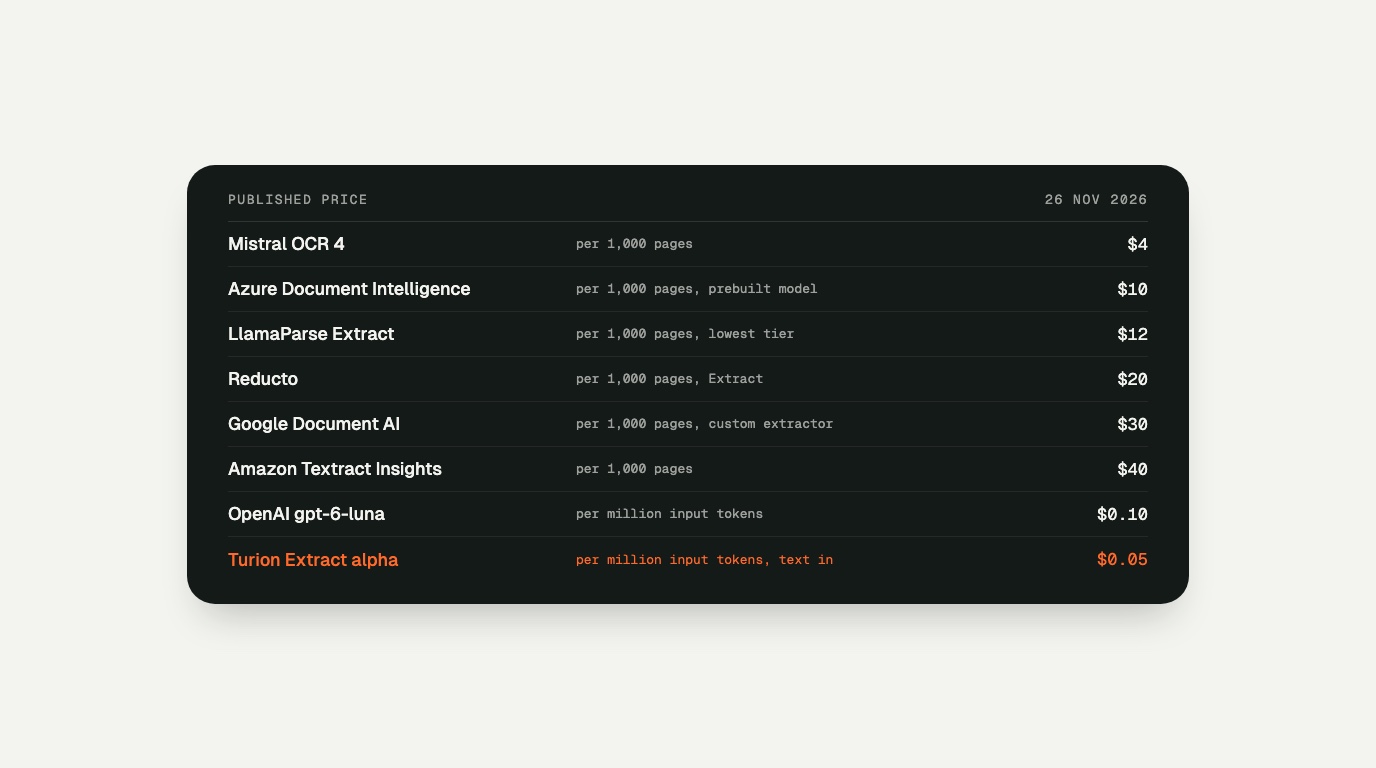
An invoice, a contract or an email comes in, and your code needs ten typed fields out of it: the parties, the dates, the total, the line items. Several APIs now do this against a schema you supply. They differ in three ways that decide which one fits: what they charge and in which unit, whether they read a scan or need text, and what comes back with each value besides the value.
This post compares them using each vendor’s own pages as they stood on 26 November 2026. Turion Extract is ours, and what it does not do is in the same tables.
Two jobs under one name
Document extraction is two jobs. The first is reading the page: turning a PDF, a scan or a photo into text with its layout. The second is filling the fields: finding the invoice number in that text and returning it as a typed value.
Most products below do both and charge per page. A general language model with structured outputs does both in one call and charges per token. Turion Extract and the text mode of NuExtract do only the second job, which makes them cheap where the text already exists (emails, tickets, chat transcripts, the output of an OCR step) and incomplete where it does not.
Prices on 26 November 2026
Each product name links to the page its price comes from.
| Product | Published price | How you say what to extract |
|---|---|---|
| Mistral OCR 4 | $4 per 1,000 pages; $5 per 1,000 pages with annotations | JSON schema for the annotations |
| Azure Document Intelligence | Prebuilt models $10 per 1,000 pages, custom models $30 (Microsoft’s retail price list, East US) | A prebuilt invoice model, or a model you train |
| Google Document AI | Custom extractor $30 per 1,000 pages, $20 above a million pages a month; invoice parser $0.10 per 10 pages | Entity labels, used as they are or fine-tuned on your documents |
| LlamaParse Extract | $12, $37.50 or $90 per 1,000 pages by tier, parsing included | JSON Schema |
| Reducto | Extract $20 per 1,000 pages with parsing included; Deep Extract $40 | JSON Schema |
| Amazon Textract | Insights $40 per 1,000 pages with 30 fields included; AnalyzeExpense $10 | A blueprint: a JSON schema with a description of each field |
| Extend | Credits at $0.01: 0.7 to 5 a page for extraction, on top of parsing at $0.002 to $0.01 a page | JSON Schema |
| LandingAI | Credits at $0.01: about 1.5 a page to parse, and extraction billed by characters | JSON Schema, applied to the parsed Markdown |
| NuExtract | Hosted: $1 per million input tokens, $5 per million output | A JSON template |
| OpenAI structured outputs | gpt-6-luna: $0.10 per million input tokens, $0.50 per million output | JSON Schema with strict: true |
| Turion Extract alpha | $0.05 per million input tokens; it writes no output tokens | A list of fields with their types |
Extend’s two figures add up to between $9 and $60 per 1,000 pages.
The token prices and the page prices are hard to compare directly, so here is one worked case. A page of plain text is around 700 tokens. A thousand such pages are 0.7 million tokens, which is about four cents on Turion Extract, plus the field list sent with each request. That figure covers the second job only. If the pages are scans, add a reader in front: with Mistral OCR 4 the two together come to a little over $4 per 1,000 pages.
What comes back with each value
A value on its own is hard to trust in a workflow. Two things make it usable: a confidence your code can set a threshold on, and a pointer to where in the document the value was read.
| Product | Reads scans and PDFs | Confidence per field | Where the value came from |
|---|---|---|---|
| Reducto | Yes | High or low, and scores from 0 to 1 | Page and bounding box |
| Extend | Yes | 0 to 1 | Page and bounding box |
| LlamaParse Extract | Yes | 0 to 1, opt-in | Page, matching text and bounding box, opt-in |
| Azure Content Understanding | Yes | 0 to 1 | Source grounding per field |
| Amazon Textract Insights | Yes | 0 to 1 | Page location |
| Google Document AI | Yes | 0 to 1 on some extractor versions | Not stated for the custom extractor |
| LandingAI | Yes | Not stated | Character ranges in the Markdown; boxes from a second API |
| Mistral OCR 4 | Yes | Per page and per word | Bounding boxes for blocks |
| NuExtract | Images, with PDFs rendered to images first | Not stated | Not stated |
| OpenAI structured outputs | Yes, as page images | Not available | Not available |
| Turion Extract alpha | Not available on turion: text only | A probability that the field is empty and a confidence for the value; not calibrated yet | Character positions in the text you sent |
“Not stated” means we did not find it on the vendor’s pages, which is different from the product not having it.
The benchmarks, and who ran them
Every published score in this field was produced by a vendor in the comparison, ours included. Read each with that in mind.
- Reducto reports 99.3% leaf accuracy for Deep Extract on LongExtractBench, a benchmark by micro1 that Reducto says it commissioned.
- Extend reports 99.2% and 99.3% for its two top tiers on LongArray-Extract, its own set of 45 PDFs.
- LlamaIndex maintains ExtractBench, 370 documents scored by value F1. Its board has LlamaParse’s top tier at 96.17, third of 62 entries, behind PageIndex at 96.72.
- Turion Extract alpha scores 75.30 on the SystemOne Extract Index 0.1, against 69.49 for Cloudflare’s Clairic. We built that index, and the model was trained on the training splits of six of its seven sources. The index tests models that fill fields in one pass over text, so it says nothing about the page-reading products above.
None of these replaces fifty of your own documents with the answers written down. Most of them have a free allowance large enough for that test.
Which one fits
Scans, long documents and a citation for every value. Reducto, Extend and LlamaParse are built for this. They read the page, return a box for each value and give a confidence to route on. Extend adds review and evaluation tooling, and LlamaParse has cheaper tiers to step down to.
You are already on one cloud. Azure, Google Document AI and Amazon Textract keep the documents inside the account you have. Google’s custom extractor can be fine-tuned on 10 to 50 of your own labelled documents, and Amazon’s Textract Insights, generally available since 20 November 2026, splits and classifies a mixed packet in the same call.
High volume and simple schemas. Mistral OCR 4 has the lowest page price in the table.
Your own GPU. NuExtract3 has open weights under Apache-2.0 and reads images. Turion Extract alpha’s adapter and inference code are also open under Apache-2.0.
A prototype or a few short documents. A general model with structured outputs is the quickest start. You get valid JSON and build the validation and the citations yourself.
Text you already have, at volume. This is where Turion Extract fits. It reads the text once and fills every field in a single pass without writing any output, which is why it bills input tokens only and answered in a median of 67 ms on one NVIDIA RTX PRO 6000 in our tests. For each field it also gives the probability that the document does not contain it, so a missing purchase order number comes back as null with a number attached.
Its limits today:
| Turion Extract alpha | |
|---|---|
| Images and PDFs | Not available on turion. Extract the text first |
| Request size | 16,384 tokens, document and fields together |
| Fields | 24 per pass; more are split across passes that each read the document again |
| Confidence | Reported, and not calibrated yet |
| Arithmetic | Sums and differences of up to three numbers, counts, and the gap between two dates |
Turion Extract: an open SystemOne Extract model explains how it works and where it scores well and badly, and the extract models guide has the request format, the field types and the errors.