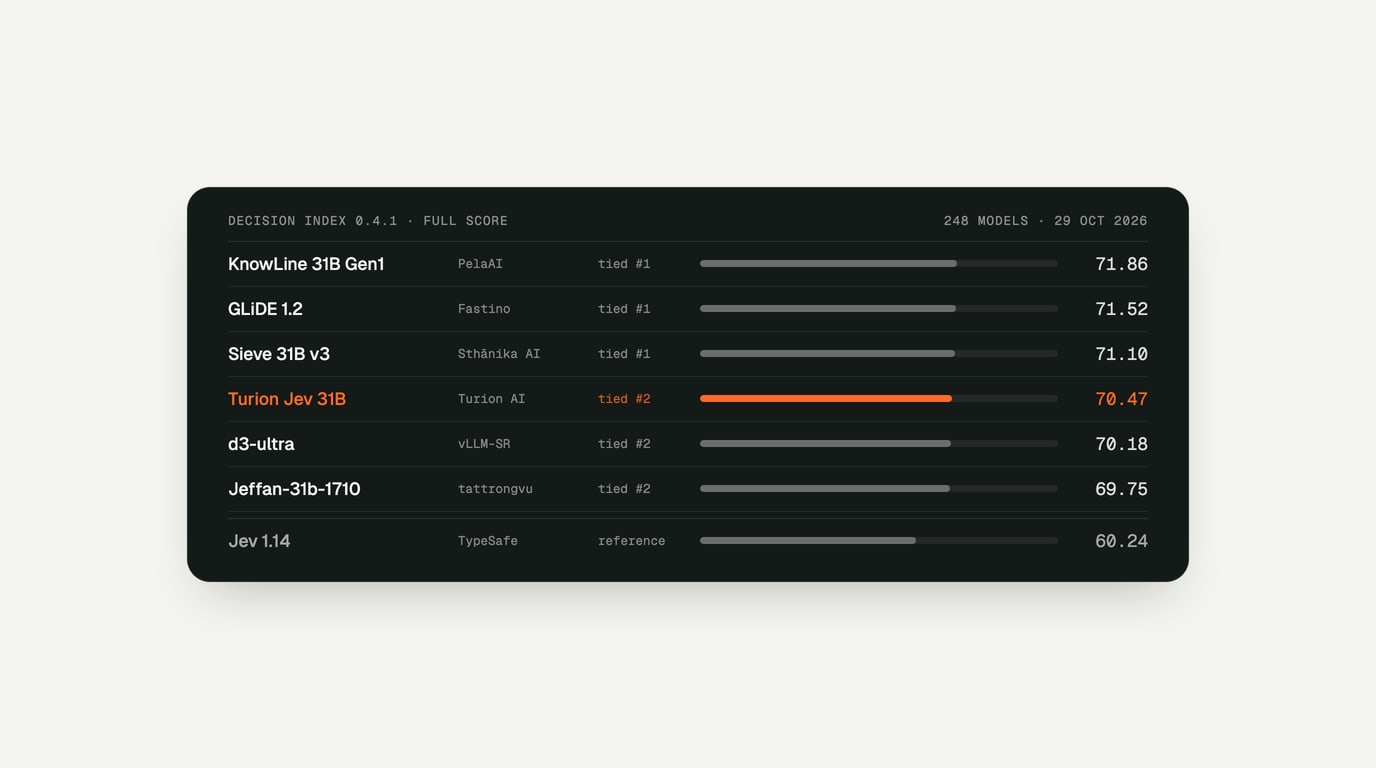
Turion Jev 31B, the decision model we trained on our own platform, is tied #2 on the Decision Index 0.4.1. The board ranks 247 open reproductions of TypeSafe’s Jev decision model, alongside Jev itself. In its 29 October update, Turion Jev scores 70.47 and shares the #2 rank with vLLM-SR d3-ultra and Jeffan-31b-1710. TypeSafe’s Jev 1.14, the reference, scores 60.24.
A decision model reads a ticket, a document or a record once and answers typed questions with a probability for every option. How decision models work explains them in more detail.
How the board ranks models
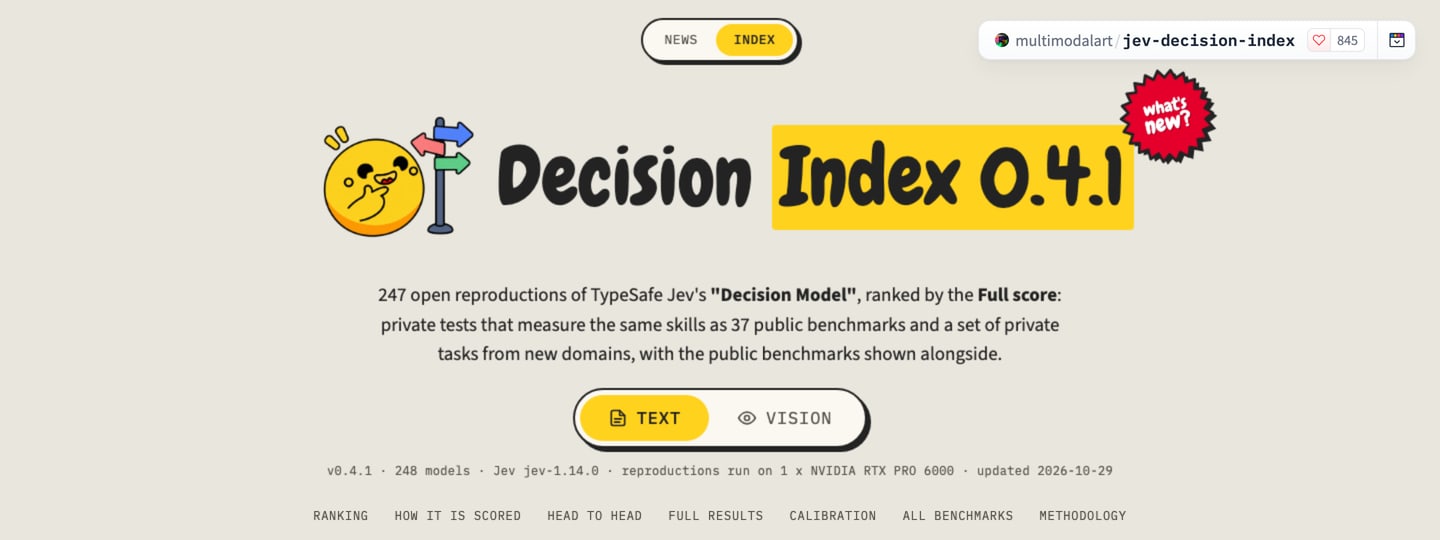
The board shows 37 public benchmarks, but they don’t count toward the rank. The rank comes from the Full score: 60% private tests that measure the same skills as the public benchmarks, and 40% private tasks from domains the public set doesn’t cover, both put on the public benchmarks’ scale. The private tests aren’t published, so no entrant can train on them.
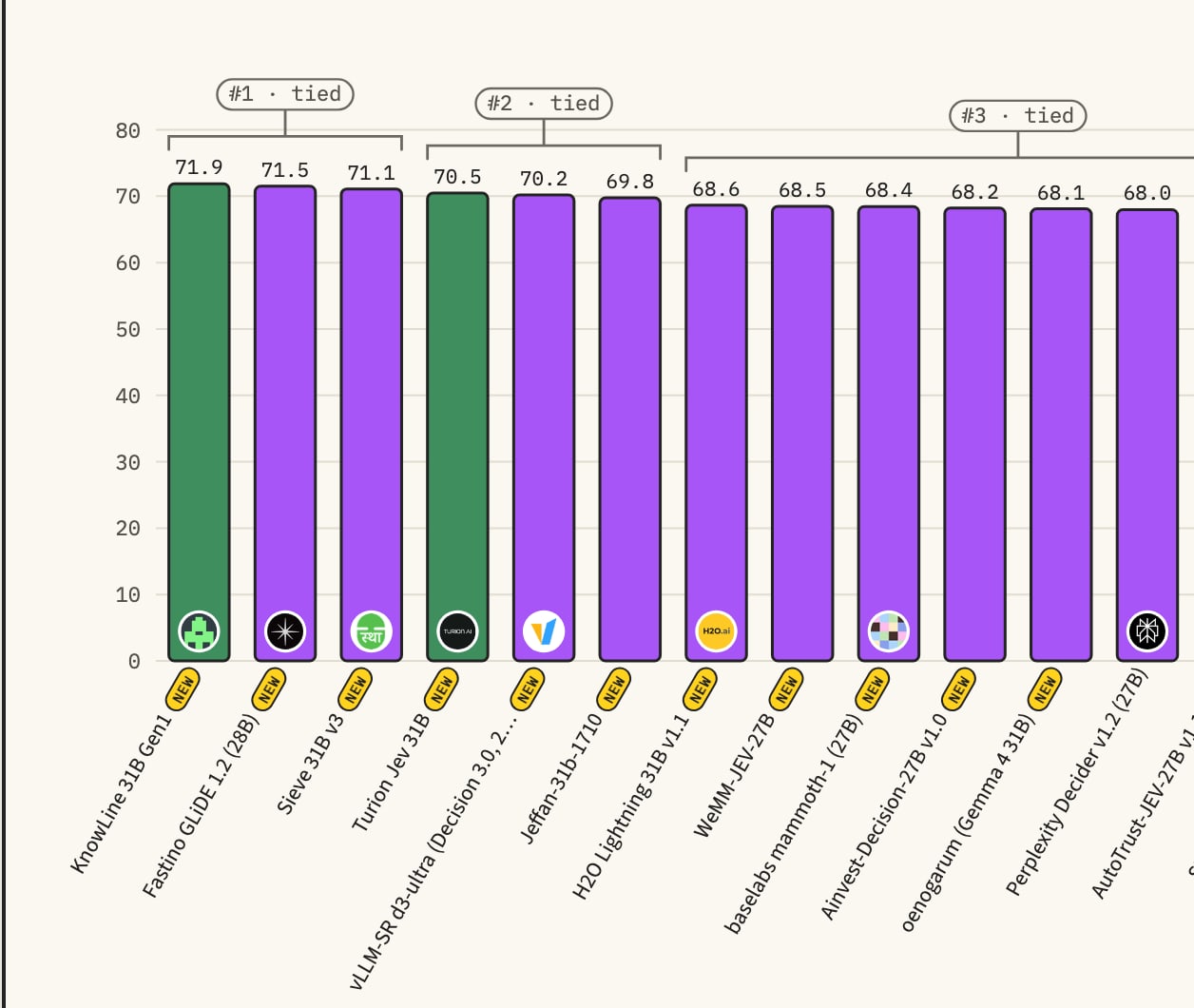
Models within 0.9 points of the first model in a group share a rank. KnowLine 31B Gen1, Fastino GLiDE 1.2 and Sieve 31B v3 are tied at #1, between 71.86 and 71.10. Turion Jev 31B leads the second group at 70.47, so it is fourth by score and tied #2 by rank.
Where it does well
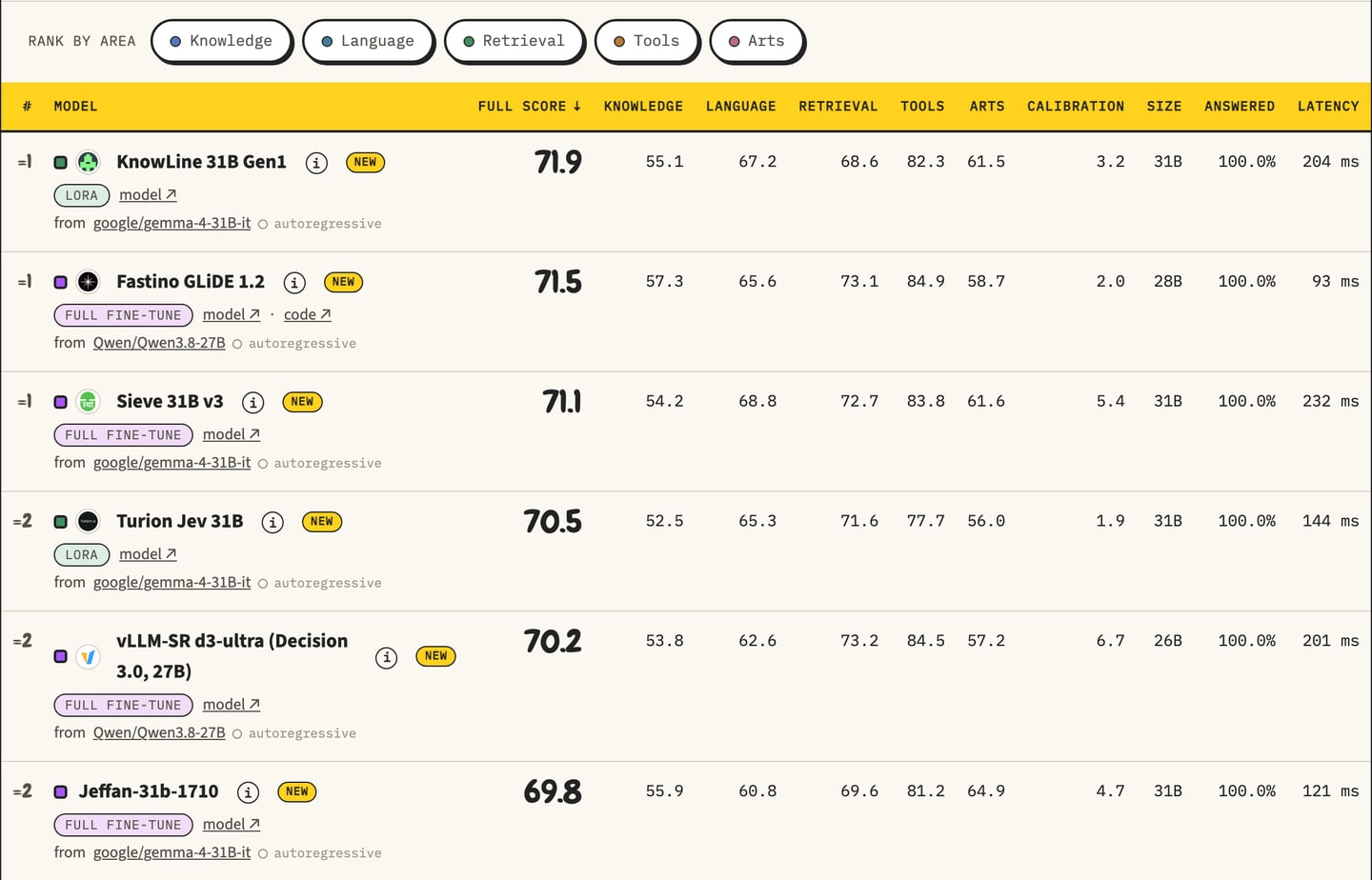
Tasks from new domains. On the private tasks from new domains, Turion Jev 31B scores 61.50, the second highest of the 248 models after KnowLine 31B Gen1 at 62.02 (from the board’s data file). These are the tasks least like anything in the public benchmarks, and the closest the board comes to a company’s own decisions.
Private tests over public benchmarks. On the public benchmarks alone it is 29th, at 66.16; on the private tests it is fourth. We checked every training row against the public suite by line match, 13-gram overlap and exact match, and dropped the 4,395 rows that overlapped. The model does better on the tests nobody could train on than on the public ones.
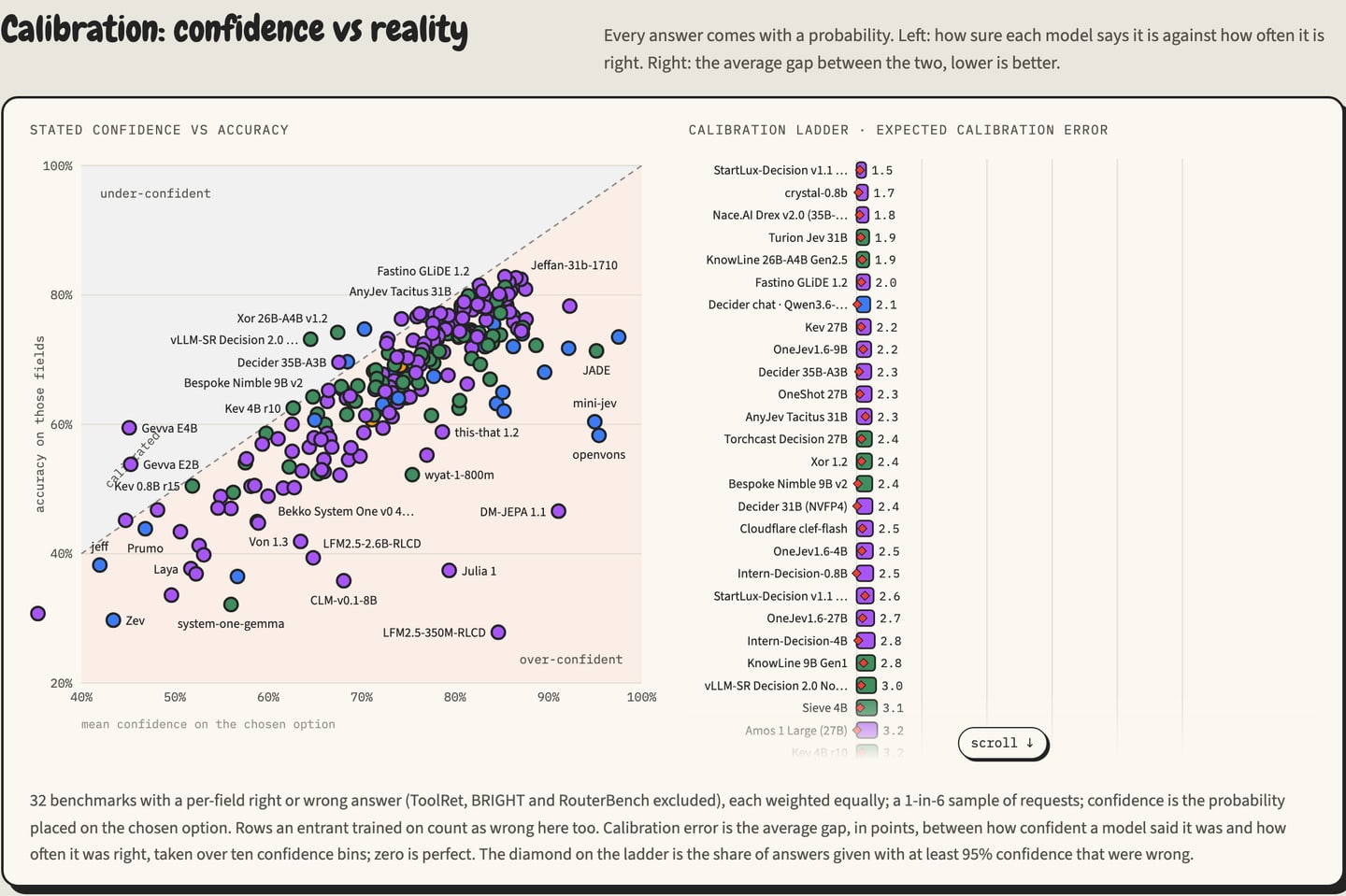
Calibration. The board measures how far each model’s stated confidence is from how often it is right. Turion Jev 31B’s calibration error is 1.9 points, the lowest in the top 20 and the fourth lowest on the board. In the board’s sample, 44% of its answers came with 90% confidence or more, and those were right 97.3% of the time. That is what lets your code act on the confident answers and pass the rest to a person.
How we trained it
Turion Jev 31B is a LoRA fine-tune of Google’s Gemma 4 31B (gemma-4-31B-it), trained as one job on the Turion platform: one NVIDIA B300 for about 7.3 hours. Its 157,106 training rows are typed decisions from 439 source datasets cleared for commercial use, about 24,500 synthetic decision tasks, an open distillation corpus, and three datasets whose annotator votes serve as probability targets. The loss compares the model’s probabilities over the options with those targets, so it learns how likely each option is as well as which one is right. One temperature per question type is then fitted on held-out data. The model card lists every source and setting.
Use it
The weights are on Hugging Face under Apache-2.0. On Turion, every workspace can call the hosted copy as turion-jev-31b with its Turion key:
turion decide turion-jev-31b \
  --state "I was charged twice for October and nobody answers my emails." \
  --noul "refund: does the customer ask for money back?" \
  --choice "team: which team should handle this? [billing|tech|sales|other]" \
  --score "urgency: how urgent is it? [can wait|this week|today]"
Calls are billed in input tokens. The hosted copy takes prompts up to 16,320 tokens, against 65,536 in the board’s run; a longer request is refused, never cut. The decision models guide covers the API and its limits.
Thanks to the Decision Index maintainers for running the private tests.