Glean is the best-known way to give a company one place to ask questions across its tools. A small company that looks at it meets two things first: there is no price on the site, and the way in is a demo with sales. This post lists what else exists for a company of 10 to 200 people, using each vendor’s own pages as they stood on 26 November 2026. One of the products, Turion Brain, is ours, and its limits are in the same tables as everyone else’s.
What Glean is
Glean is an enterprise AI search and assistant built on what it calls a permission-aware knowledge graph. Its pricing page lists more than 275 connectors, answers with their sources cited, and the line “Users only see what they’re allowed to see”. It has no figures, and the one action is “Get a demo”.
Glean runs either hosted on Google Cloud or in the customer’s own Google Cloud or AWS account, where Glean still operates it (deployment options). It also has an MCP server that Claude, ChatGPT and Cursor can connect to, billed by usage.
If your company has several hundred people, documents with their own sharing rules in dozens of systems, and time for a procurement process, Glean was built for that, and it is a reasonable place to stay.
What a small company should check
Five questions separate the products below.
- Is the price published, and can you start without talking to sales?
- What is priced: seats, credits or connected tools? A seat price grows with headcount, and a price by tool grows with how much of the company is connected.
- Does an answer follow each document’s own sharing settings, or is access set once for a whole tool?
- Can the assistants your people already use, such as Claude and ChatGPT, read it?
- Can you run it on your own servers?
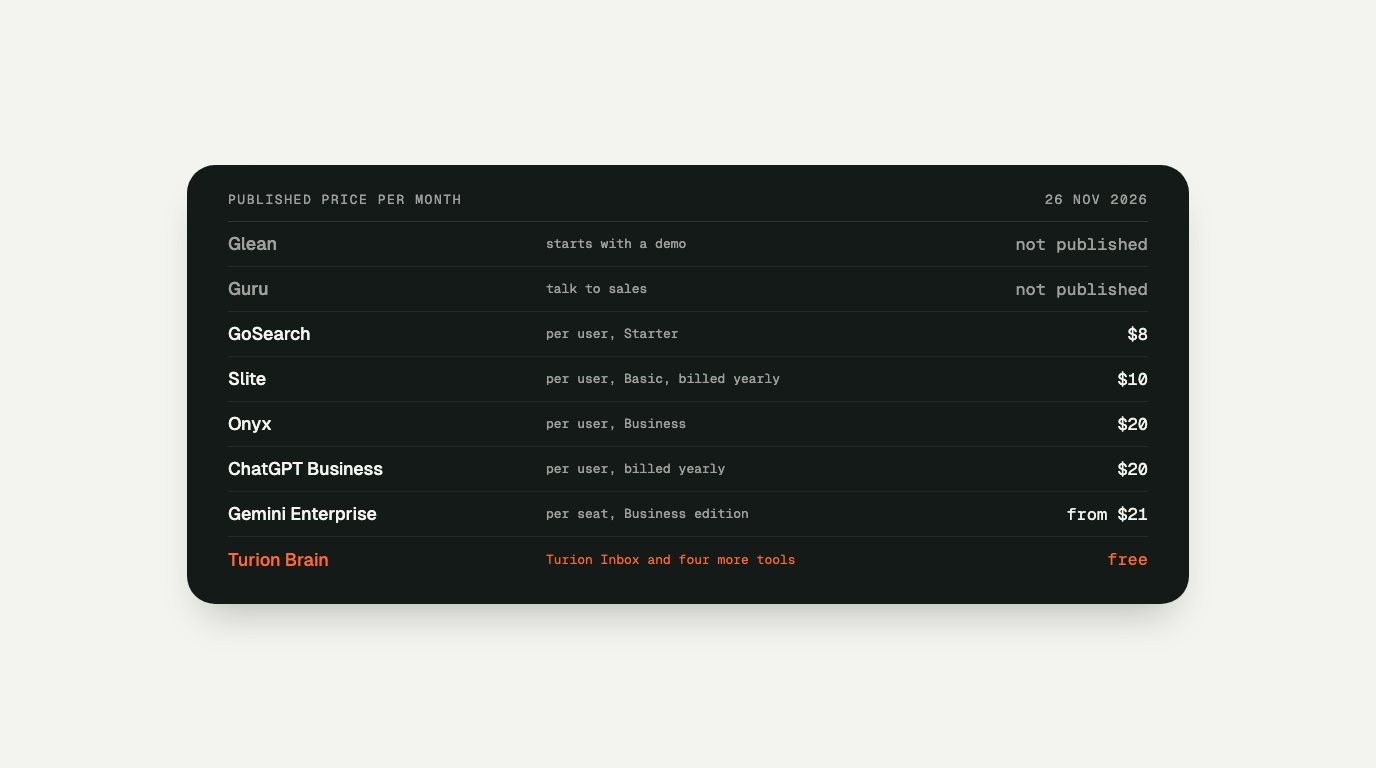
Published prices on 26 November 2026
Prices are per user per month unless the row says otherwise, and each product name links to the page the figure comes from.
| Product | Published price | Start without sales |
|---|---|---|
| Glean | Not published | No |
| Guru | Not published | No |
| GoSearch | Free plan; Starter $8, Pro $12 | Yes |
| Slite | Basic $10, Pro $20, billed yearly | Yes, 14-day trial |
| Notion | Plus $10, Business $20 | Yes |
| Onyx | Business $20; the Community Edition is free to self-host | Yes |
| ChatGPT Business | $20 billed annually, $25 monthly, from 2 users | Yes |
| Gemini Enterprise, Business edition | From $21 | Yes, 30-day trial |
| Microsoft 365 Copilot Business | $18 paid yearly until 31 December 2026, then $21, on top of a Microsoft 365 Business plan | Yes |
| Dust | Pro €24 billed yearly or €30 monthly, before VAT | Yes, with a free seat |
| Atlassian Rovo | Credits included with paid Jira and Confluence cloud plans; extra use at $0.01 a credit | Yes, for Atlassian cloud customers |
| Turion Brain | Free with Turion Inbox and four more tools; more tools are the Growth plan at $1,500 a month plus usage | Yes, no card |
Two rows need a note. Slite’s search across connected tools is on its Pro plan, and Notion’s Enterprise Search starts at its Business plan, so the lower plan in each row searches only the product’s own pages. Atlassian says usage-based billing for Rovo starts on 3 December 2026.
The assistant you already pay for
If the company already works inside one suite, that suite’s own search is the shortest path, and it costs the least to try.
Microsoft 365 Copilot suits a company on Microsoft 365. Its connectors either copy outside content into Microsoft Graph or fetch it at the moment of the question, and people can open the citations in an answer.
Gemini Enterprise suits a company on Google Workspace. The Business edition is self-serve and comes with a selection of the product’s connectors; the larger editions are sold by Google’s sales team.
ChatGPT Business suits a team that already pays for ChatGPT. Its company knowledge reads Google Workspace, Slack, GitHub and Microsoft 365 among others, gives source links, and respects the permissions of the connected source.
Notion suits a team whose documents are already in Notion. Its connectors cover Slack, Microsoft Teams, Google Drive, SharePoint, Salesforce, GitHub and a few more, and Notion says new content can take up to 36 hours to be read in.
Atlassian Rovo suits Jira and Confluence cloud customers, who already have its credits in their plan.
Slite suits a small team whose main need is a wiki, with search across other tools as an addition.
What these have in common is that the knowledge sits inside one vendor’s assistant. That is fine while everyone uses that assistant. It matters once part of the team prefers another one, or once you want your own software to read the same records.
Products built for the job
Onyx, formerly Danswer, is the open-source choice. Its Community Edition is under the MIT licence and deploys with Docker or Kubernetes, and the paid plans add features such as syncing each document’s permissions for some connectors. Its connectors copy and re-sync content on a schedule, and any MCP client can be pointed at it. A team with an engineer who wants the data on its own servers should look here first.
GoSearch has the lowest seat price in the table and a free plan. It lists more than 100 apps and offers deployment in the customer’s own cloud account.
Dust is aimed at building agents on top of company knowledge. Its self-serve plan is described as for teams of up to 100 people, and other assistants such as Claude can connect to it.
Guru keeps knowledge that a team has verified, and says every answer includes citations. It has an MCP server for ChatGPT, Claude and Cursor. Like Glean, it does not publish a price.
Turion Brain
Turion Brain copies the records from the tools a company connects (help desk, CRM, inbox, shared drive) into one private knowledge graph: customers, deals, tickets and documents, and how they connect. Every record keeps a link back to the tool it came from, which is how an answer shows where it got its facts.
Three things set it apart from the products above.
It is priced by connected tools and has no seat price. A brain with Turion Inbox and four more tools is free and does not need a card.
It is open to the assistants people already use. Each brain has a read-only MCP server that Claude and ChatGPT connect to by signing in, so a team split between two assistants asks the same records. People can also ask in the turion workspace in a browser or on Telegram.
The same records are what Turion Jev and Turion Extract read when they answer a routine question, such as which team gets a ticket, and what a model trained for the company later learns from. What ChatGPT, Claude, and Copilot know about your company covers that path.
Next to Glean, as of this writing:
| Glean | Turion Brain | |
|---|---|---|
| Price | Not published | Free with five tools; Growth at $1,500 a month plus usage for more |
| Start | Demo with sales | Sign up and connect a tool |
| Connecting a tool | More than 275 connectors | Sign in to the tool or paste a read-only key for the tools the sync reads; we set up any other tool with you |
| Access to answers | Follows each user’s permissions in the source | Not available on turion: a tool is open to the whole workspace or kept to its owners and admins |
| Running it in your own cloud | In your own Google Cloud or AWS account, operated by Glean | Not available on turion: brains run on turion’s servers in the United States (Virginia) |
| Claude and ChatGPT | MCP server, billed by usage | MCP server, read-only |
Your records are not used to train any model, turion’s own models included. A model is trained on your data only if you ask us to train one for your company, and that model belongs to you.
How to choose
A company that lives in Microsoft 365, Google Workspace, Notion or Jira should try that suite’s search first. A team with an engineer and a reason to keep data on its own servers should start with Onyx. If the lowest seat price decides it, that is GoSearch. A company that needs answers to follow every document’s sharing settings across many systems needs Glean or Onyx’s paid plans, and Turion Brain is the wrong choice for it today.
Turion Brain fits a company that wants its records in one place that Claude, ChatGPT and its own agents can all read, at a price that does not depend on headcount. You can start a brain for free and connect the first tool yourself.